April 21, 2008
1 min read
 Add Us On GoogleAdd SciAm
The Geometry of Western Music
A new way of visualizing Western music theory could inspire innovations in everything from musical instrument design to music composition techniques—even to new kinds of toys.
On supporting science journalism
If you're enjoying this article, consider supporting our award-winning journalism by subscribing. By purchasing a subscription you are helping to ensure the future of impactful stories about the discoveries and ideas shaping our world today.
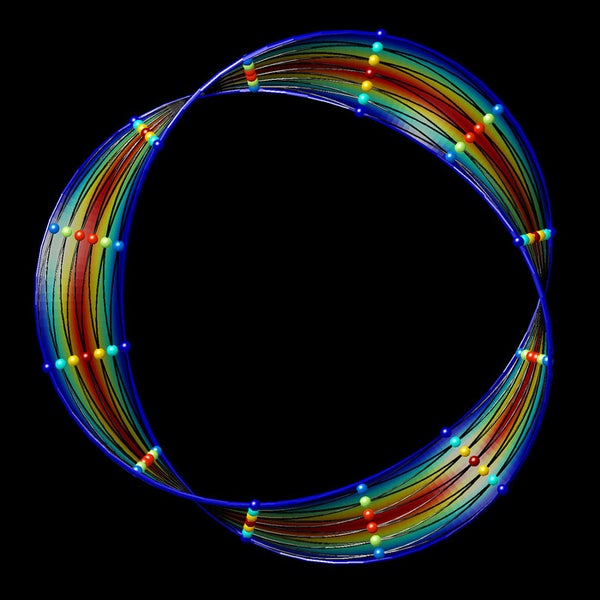
A new way of visualizing Western music theory could inspire innovations in everything from musical instrument design to music composition techniques—even to new kinds of toys. So say three music professors who outlined a "geometrical music theory" for translating families of notes into geometric figures, such as this doubly twisted Mobius strip representing the space of all two-note chords. Each node in the figure stands for a different chord, and each pair of adjacent nodes differs by one note. "Imagine going to a classical music concert where the music was being translated visually," said the classification scheme's co-creator Dmitri Tymoczko, an assistant professor of music at Princeton University, in a statement. "We could change the way we educate musicians." To educate yourself on the new method, check the April 18 issue of Science.
It’s Time to Stand Up for Science
If you enjoyed this article, I’d like to ask for your support. Scientific American has served as an advocate for science and industry for 180 years, and right now may be the most critical moment in that two-century history.
SciAm always educates and delights me, and inspires a sense of awe for our vast, beautiful universe. I hope it does that for you, too.
If you subscribe to Scientific American, you help ensure that our coverage is centered on meaningful research and discovery; that we have the resources to report on the decisions that threaten labs across the U.S.; and that we support both budding and working scientists at a time when the value of science itself too often goes unrecognized.
In return, you get essential news, captivating podcasts, brilliant infographics, can't-miss newsletters, must-watch videos, challenging games, and the science world's best writing and reporting. You can even gift someone a subscription.
There has never been a more important time for us to stand up and show why science matters. I hope you’ll support us in that mission.