
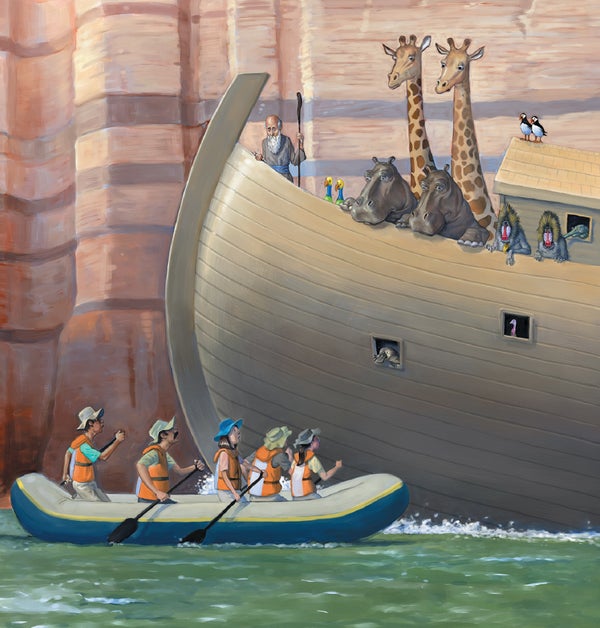
The mantra issued by the guides was as clear as the silty Colorado River was opaque: “If you're hot, you're stupid.” And so I spent most of my waking hours on and along the river dipping into the 50 degrees Fahrenheit water to counter the 100 degrees F air temperature. I was not hot, but I sure was soaked.
Welcome back for the second part of my tale of the July boat trip through the Grand Canyon with the NCSE, the National Center for Science Education—a trip intelligently designed to include discussions of how scientists see the canyon's formations as billions of years of history written in rock versus how Young Earth creationists see the canyon as evidence for Noah's flood a week ago Thursday. Okay, I'm just kidding. What they believe is that the flood in question happened some 4,400 years ago and produced the geology and fossils of the canyon. Now I'm not kidding. The NCSE works tirelessly to keep that story from being included in public school science classes: Noah … uh, no.
Our group of 25 passengers and crew included the NCSE's Steve Newton, a geologist, and Josh Rosenau, an evolutionary biologist, who discussed the science behind the rock formations, stratigraphy and fossils we saw—and how the aforementioned creationists view the same physical landscape. We got an unexpected taste of that worldview while stopped briefly within the immense Redwall Cavern: two members of the NCSE group overheard a man from a very different tour explaining to his mates that the Almighty cut up big fishes to create little fishes. As Kenneth the page on the NBC sitcom 30 Rock famously said, “Science was my most favorite subject, especially the Old Testament.”
On supporting science journalism
If you're enjoying this article, consider supporting our award-winning journalism by subscribing. By purchasing a subscription you are helping to ensure the future of impactful stories about the discoveries and ideas shaping our world today.
One of the canyon's most obvious points of disagreement between scientists and creationists is what is known as the Great Unconformity—an unconformity is a gap in the geologic record, and this one is pretty great. Under it lies 1.75-billion-year-old rock with the magnificent name of Vishnu Schist. The metamorphic schist is heated and squeezed underneath the earth's surface and gets exposed by uplift and erosion. Directly above the schist is 525-million-year-old Tapeats sandstone. In between is, well, 1.25 billion years conspicuous by its absence.
About halfway through our 226-mile outing, we reached Blacktail Canyon—where visitors can put their hands on that seam in time, only about five feet higher than the ground we walked on. “This is a spot that a lot of creationists come to,” Newton said, with the epochal border seam near his elbow. “We've been seeing this Great Unconformity for quite a while—it's been high up in the hills. But this is a spot you can actually come to and touch. From the creationists' interpretation, these are the original rocks of the world—day three, separation of the waters and the land. I can appreciate that it's pretty amazing to touch those rocks. And then the moment of the flood,” he said, pointing at the sandstone layer adjoining the schist.
“And that is, you might not be surprised, not what scientists think about all this,” Newton continued. “So there's a gap, about 1.2 billion years … you should touch this and realize a quarter of the [history of the 4.5-billion-year-old] world is missing right here … think of all the mountain chains that rose up and then were worn down … and of all the life-forms that lived and died … in that gap.”
Try to imagine a billion years passing—our brains may not be up to that task. So I can see how a subset of humanity refuses to buy deep time and believes that everything that ever happened happened to happen in the past six millennia. The First Amendment to the Constitution grants American citizens that right. But as numerous trial verdicts have agreed, that same amendment prohibits the short version of history—and its antievolution corollaries—from being taught in public schools as science. Creationism in biology classes would make our educational system the way I was in the canyon—all wet.