
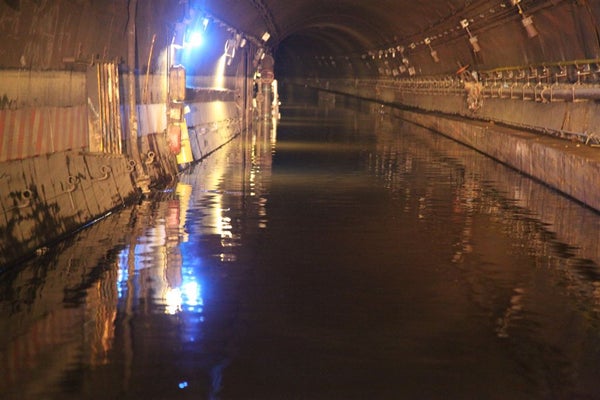
The Greater New York City region has done good work in the years since Superstorm Sandy to consider storm-related flooding, but a new report by the Regional Plan Association found that the more pernicious threat of sea-level rise needs more attention.
The report breaks sea-level rise into "what-if" scenarios for 1-, 3- and 6-foot sea-level rise increments in the tri-state region. It finds that many of the major resilience policies, plans and projects under development fall short of addressing the long-term, existential threat of permanent flooding from sea-level rise.
It's "long past the point where sea-level rise can be ignored in the hope that future technology will provide an easy solution," said the association, an independent urban research and advocacy organization for New York, New Jersey and Connecticut.
On supporting science journalism
If you're enjoying this article, consider supporting our award-winning journalism by subscribing. By purchasing a subscription you are helping to ensure the future of impactful stories about the discoveries and ideas shaping our world today.
The region, home to 23 million people, needs to start planning for sea-level rise now, said Rob Freudenberg, director of energy and environment programs at the association and the lead author of the report.
"So much of the funding and projects and attention has gone to preparing our region for future storms, which is absolutely necessary," Freudenberg said. "But a lot less attention has been paid to the current flooding that will result from sea-level rise."
Without additional protection measures, 1 foot of sea-level rise will inundate nearly 60 square miles of the tri-state region. That's about 19,000 people in 10,000 homes, in places where about 10,000 people work. It could happen as soon as 2050 if emissions aren't curtailed, the report found.
In New York City, for example, much of the city's coastline is hardened. But there would be several areas of major vulnerability: Jamaica Bay, Flushing Bay and the eastern shore of Staten Island.
In New Jersey, the communities of Moonachie and Secaucus, as well as Teterboro Airport, face inundation at 1 foot of sea-level rise. As many as 3,000 people around Barnegat Bay and Toms River live in places that could be inundated with 1 foot of water near the New Jersey shore.
"With sea-level rise, over time, water will keep coming and coming and coming, and it won't go away," Freudenberg said. "So we're going to be living, in parts of our region, with permanent flooding without even getting a storm."
The report notes that over time, the region's airports are among the infrastructure most threatened by sea-level rise. So, too, are rail lines that service much of the East Coast.
But the region can't wall off its 3,700-mile coast from the sea, the report said. Nor can it retreat from every future flood zone.
"We have to start thinking about a future where we're going to have to make decisions about where we can invest limited funds to protect, and where we can invest limited funds to retreat," he said.
Beyond preparing for the inevitable, the report also calls for climate mitigation, including implementing the 2015 Paris Agreement in order to have "any hope of avoiding catastrophic effects from sea-level rise and other outcomes of global warming."
Although the primary responsibility is at the federal level, state and local governments can have a substantial mitigation impact through land-use, energy and transportation policies.
The Regional Plan Association produces a major plan for the region about every 30 years. The most recent, issued in 1996, had little consideration for sea-level rise, Freudenberg said.
"Climate change, back then, was this thing we were worried about," he said. "Now it's something that we're living with."
Reprinted from ClimateWire with permission from E&E News. E&E provides daily coverage of essential energy and environmental news at www.eenews.net.