
Fevers, Feuds, and Diamonds: Ebola and the Ravages of History
by Paul Farmer Farrar, Straus and Giroux, 2020 ($35)
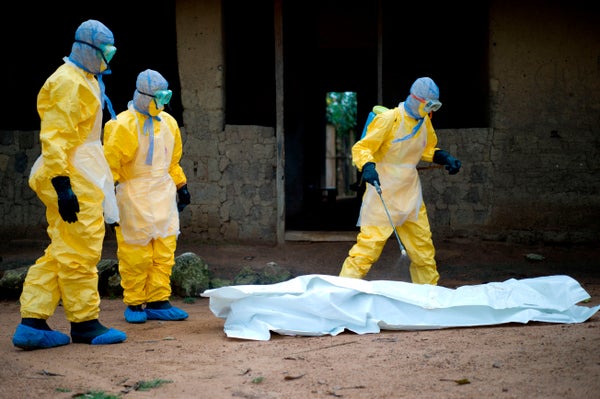
At the end of June the World Health Organization declared that the 10th outbreak of Ebola in the Democratic Republic of Congo was officially over, after two years and 2,287 deaths. It was the latest severe outbreak and most likely not the last. In this riveting first-person account of the even deadlier 2013–2016 outbreak in West Africa, Farmer, the renowned American physician and founder of Partners in Health, lays out both an intimate look and a 10,000-foot view of the dire public health situation there. A history of colonial oppression, exploitation by mining interests and racism has contributed to civil war and poverty. Such unrest, he argues, has led to so-called medical deserts, whereby disease treatment is limited and survival rates are tragically low, compared with richer nations. Arriving in West Africa in the midst of the outbreak in 2014, Farmer recounts the difficult clinical circumstances faced by local Ebola treatment units and weaves in the stories of local doctors and survivors who played a central role in confronting the terrible disease.
The Janus Point: A New Theory of Time
by Julian Barbour
Basic Books, 2020 ($32)
On supporting science journalism
If you're enjoying this article, consider supporting our award-winning journalism by subscribing. By purchasing a subscription you are helping to ensure the future of impactful stories about the discoveries and ideas shaping our world today.
Imagine a cosmos in which the arrow of time flies backward. Mountains rise from windblown dust. Decrepit bodies bob up from graves, becoming youthful before shrinking to disappear inside a mother's womb. Planets, stars and galaxies dissolve into glowing, dense plasma that pervades a collapsing universe. In all things, disorder gives way to order—entropy inexorably decreases—rather than vice versa, as in the everyday reality we experience. As far-fetched as all this seems, in The Janus Point, physicist Barbour argues with poetic erudition for a solution to the vexing problem of time's apparent one-way flow: a mirrorlike temporal duality in which the big bang is not an explosive cosmic beginning but rather “a special point on the time line of the universe.” —Lee Billings
The Organ Thieves: The Shocking Story of the First Heart Transplant in the Segregated South
by Chip Jones
Gallery Books/Jeter Publishing, 2020 ($28)
Black Americans receive inferior health care on all scores—from general wellness checks to treatment for chronic illness, which leads to worse health outcomes. They are 60 percent more likely to be diagnosed than white people with diabetes, for example, and 40 percent more likely to be diagnosed with hypertension. The roots of this inequity are firmly rooted in racism, not race, writer Jones shows in this gripping book. Examples go back to the earliest days of the U.S.—he recounts the legal battles that arose in the 18th century and later over body snatching from Black graveyards for medical research. In 1968 doctors extracted, without his consent, the beating heart of Black factory worker Bruce Tucker for transplant into a white businessman, after Tucker suffered a head injury. Sadly, such disregard for patients' rights is not reserved for history.
