
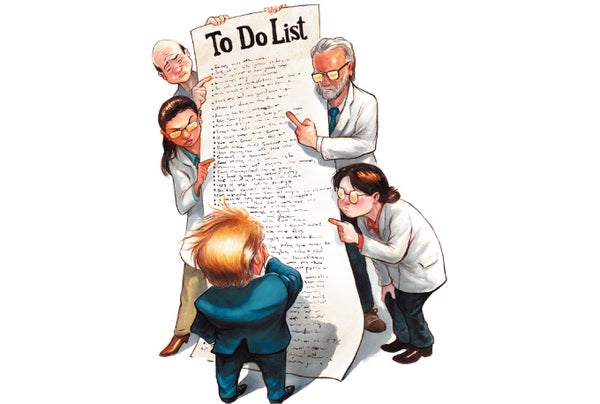
Dear President Trump and members of Congress:
As you took office in January, you came face-to-face with pressing problems involving science, medicine and technology that directly affect our country's health, wealth and security. They have often been ignored by your predecessors or simply “kicked down the road” in a meaningless way. Your critics fear that you will do something more dangerous: not simply defer crucial decisions but actively promote policies that ignore overwhelming scientific evidence about climate change, vaccines, national security and other issues. Some statements both from you as the incoming president and from majority party representatives in Congress about such topics have been worrisome.
But you have the opportunity to make real changes for the good of the whole nation, with actions using fact-based approaches and common ground.
On supporting science journalism
If you're enjoying this article, consider supporting our award-winning journalism by subscribing. By purchasing a subscription you are helping to ensure the future of impactful stories about the discoveries and ideas shaping our world today.
We do not expect politicians elected on broad promises to shrink government and undo regulations to agree with us about the value of all policies. We are sure, however, that you would agree with President Dwight D. Eisenhower, who, when mobilizing the U.S. to deal with new threats in a post–World War II world and a changing economy, told the nation that “love of liberty means the guarding of every resource that makes freedom possible—from the sanctity of our families and the wealth of our soil to the genius of our scientists.” The actions we list below not only guard those resources but will help them flourish.
Health costs: Start by giving Medicare, the nation's largest insurance program, the power to negotiate prices with pharmaceutical companies. Government on the federal and state level also needs to continue efforts to make health care affordable by reforming the Affordable Care Act to eliminate double-digit premium price hikes and by maintaining inexpensive insurance coverage for the millions who have obtained it already.
Earth and climate: NASA's ability to observe Earth helps us understand the way changing sea levels impact our defense forces and how groundwater shortages affect our farmers, not just to grasp the scope of global warming. We need to maintain both the money and the expertise to continue high-quality observations, no matter which agency carries them out.
Clean energy: The U.S. needs to implement the Clean Power Plan for power plants—under court review this winter—as part of our commitment to reduce greenhouse gas emissions, made during the international COP21 climate agreement in Paris.
Natural resources: Groundwater supplies, essential for crop irrigation and drinking water, are threatened by pollution. Protect them by giving the Environmental Protection Agency the resources to enforce newly enhanced laws governing toxic substances and chemical safety, as well as the Safe Drinking Water Act.
Cybercrime: Criminals have stolen important private information about Americans from government agencies, such as the Office of Personnel Management, and private companies, such as Yahoo. Organizations that hold such data must be made to shore up their digital vulnerabilities, either through policy that dictates specific high-level security measures or through penalties if such measures are not taken. The president must also seek international cooperation in combating attacks, given the lack of borders that exist online.
Space: Appoint a NASA administrator and determine the country's future space plans on a long-term basis, not one that changes with every election. Appoint a board of scientists charged with developing these goals, with terms that exceed those of an individual president or Congress.
These are not simple tasks, especially in a nation with the divided political values seen in the popular vote count of the November presidential election. But another president, the one who succeeded Eisenhower, inspired this country to choose to do things “not because they are easy but because they are hard.” That chief executive, John F. Kennedy, told us that the tough challenges “measure the best of our energies and skills.” When we succeed at them, when we craft policies that benefit our soil and rely on our science, they bring out the greatness in us all.