
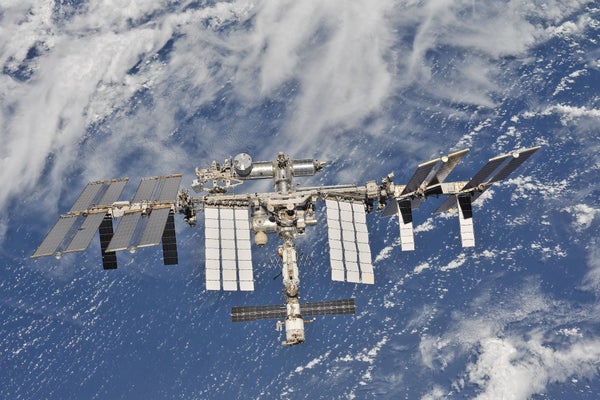
The
International Space Station (ISS) is taking a big step toward increased commercial use.
NASA has picked Houston-based company
On supporting science journalism
If you're enjoying this article, consider supporting our award-winning journalism by subscribing. By purchasing a subscription you are helping to ensure the future of impactful stories about the discoveries and ideas shaping our world today.
Axiom Space to build at least one habitable private module that will be attached to the orbiting lab, the space agency announced Monday (Jan. 27).
NASA hopes the Axiom module helps spur the growth of an off-Earth economy, one that eventually extends far beyond the ISS in both time and space.
"Axiom's work to develop a commercial destination in space is a critical step for NASA to meet its long-term needs for astronaut training, scientific research and technology demonstrations in low-Earth orbit,” NASA Administrator Jim Bridenstine
said in a statement.
"We are transforming the way NASA works with industry to benefit the global economy and advance space exploration," he added. "It is a similar partnership that this year will return the capability of American astronauts to launch to the space station on American rockets from American soil."
Bridenstine was referring in that last sentence to NASA's Commercial Crew Program, which has funded the development of two private crew capsules,
SpaceX's Crew Dragon and Boeing's CST-100 Starliner. The agency is counting on these homegrown astronaut taxis to end American reliance on Russian Soyuz rockets and spacecraft to get folks to and from the ISS.
Bridenstine has stressed that NASA wants to be just one of many customers for Starliner and Crew Dragon. The agency's vision is similar for these vehicles' destinations: If all goes according to plan, a variety of private companies, university groups and other customers will take advantage of the ISS and other outposts that eventually set up shop in Earth orbit.
These other outposts are key, for the ISS won't last forever. Indeed, the station is currently funded only through 2024 (though operations could end up being extended through 2028, or perhaps even later). Axiom aims to build and operate its own space station in the near future, as do several other companies, including Las Vegas-based Bigelow Aerospace.
Bigelow already has some hardware attached to the ISS — the
Bigelow Expandable Activity Module (BEAM), which arrived at the orbiting lab in April 2016 to validate the company's expandable habitat technology for crewed in-space use. BEAM has performed very well during its nearly four years in orbit, NASA officials have said, and the agency plans to keep it on the station (and use it for storage) through the late 2020s.
The Axiom module will be affixed to the ISS' Node 2 forward port, NASA officials said. The main goal is to demonstrate the module's commercial potential and aid the transition toward greater private use of the orbiting lab — a
key agency priority — and the final frontier in general.
Axiom's winning proposal was submitted in response to a call via Appendix I of NASA's Next Space Technologies for Exploration Partnerships (NextSTEP) 2 Broad Agency Announcement, which offered companies the use of ISS utilities and a port.
"NASA and Axiom next will begin negotiations on the terms and price of a firm-fixed-price contract with a five-year base performance period and a two-year option," NASA officials wrote in the same statement.
"Because commercial destinations are considered a key element of a robust economy in low-Earth orbit, NASA also plans to issue a final opportunity to partner with the agency in the development of a free-flying, independent commercial destination," they added. "Through these combined efforts to develop commercial destinations, NASA is set to meet its long-term needs in low-Earth orbit well beyond the life of the station."
Copyright 2020 Space.com, a Future company. All rights reserved. This material may not be published, broadcast, rewritten or redistributed.