
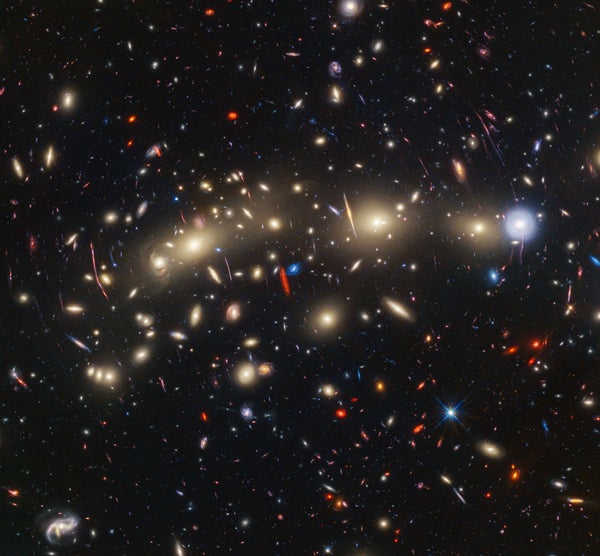
Astronomers studying a distant galaxy using the James Webb Space Telescope (JWST) have found the best candidates yet for the universe’s first stars.
These so-called Population III stars arose shortly after the big bang and formed from the primordial hydrogen and helium that then pervaded the universe. Shining brilliantly but briefly, they would have ended their lives in explosive supernovas that forged and scattered heavier elements, enriching the cosmos with material for subsequent stellar generations. JWST was purpose-built to help astronomers find Population III stars, but that task has proved extremely difficult because of how far away in space and time these short-lived stars are from our present.
The latest candidates reside in a galaxy called LAP1-B, which is located more than 13 billion light-years away. A larger, intervening galaxy cluster that is closer to us acts as a giant magnifying lens for LAP1-B’s faint, distant light. Looking at that light, astronomers found clear evidence of helium in LAP1-B—but virtually no heavier elements, as would be expected from an early galaxy filled with Population III stars.
On supporting science journalism
If you're enjoying this article, consider supporting our award-winning journalism by subscribing. By purchasing a subscription you are helping to ensure the future of impactful stories about the discoveries and ideas shaping our world today.
The new finding is not a smoking gun, but this is “the closest we are yet” to finding the most ancient stars, says astronomer Jorryt Matthee of the Institute of Science and Technology in Austria, who was not involved with the work.
The team behind the new study, published in October in the Astrophysical Journal Letters, noted there is still uncertainty because LAP1-B’s apparent lack of heavier elements could be explained in other ways. For instance, JWST could have detected unusually pristine clouds of gas rather than actual Population III stars.
Deeper studies of LAP1-B could provide more clarity. The absence of any trace of oxygen in the galaxy, for example, would bolster the case that this galaxy truly contains some of the universe’s first stars. But, Matthee cautions, an absence of evidence is not evidence of absence—especially when viewing something so far away. “It is very difficult to prove that heavy metals are not there,” he says.
Editor’s Note (11/19/25): This article was edited after posting to correct the description of the larger, intervening galaxy cluster and Jorryt Matthee’s current affiliation.