The Lost Worlds of Soviet Space Graphics [Slideshow]

A new book captures the pioneering, propaganda-infused visions of mid-20th-century Soviet space exploration

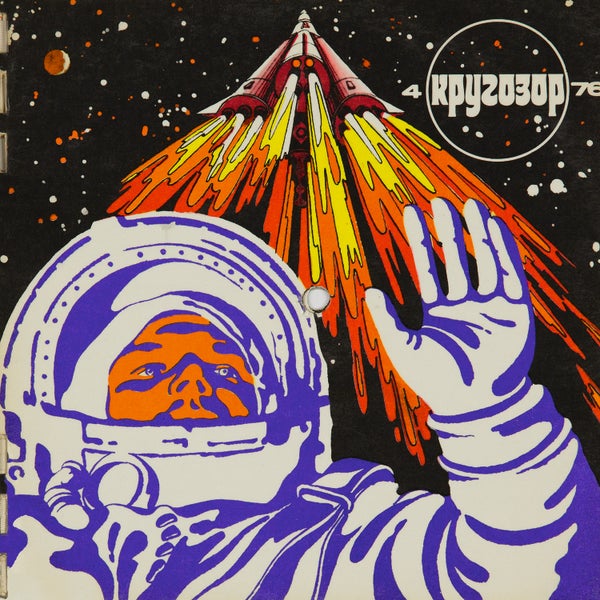
Yuri Gagarin: Let’s Go! Illustration by S. Alimov in Outlook, No. 4; 1976. The magazine’s accompanying “flexi disc” record began with a track by cosmonaut Yuri Gagarin entitled “Planet Earth Is Beautiful.”

Phaidon and the Moscow Design Museum

Join Our Community of Science Lovers!

The future isn’t what it used to be. A mere half-century ago, it was entirely possible to envision a world—a universe—in which the Soviet Union, not the U.S., would win the cold war–fueled space race and become the dominant nation on Earth and beyond. Spin-off technologies from space exploration would spectacularly enrich socialist economies, a Soviet lunar base would ensure a “Red moon” loomed over our planet, and cosmonauts would create outposts or colonies on Mars. And whenever humankind made the giant leap to the stars, our first emissaries would take the tenets of communism with them to share with any cosmic civilizations we found.

Instead, of course, the U.S. triumphed in both the space race and cold war. The rest, as the saying goes, is history. But the legacy of those techno-socialist utopian dreams still endures—especially in the art and design produced in the Soviet Union during the turbulent, transformative mid-20th century. A new retrospective compendium, Soviet Space Graphics(Phaidon, 2020; $39.95), showcases some of the best work from this bygone era.

Here we present a selection of images from the book. With their heady mix of quasi-religious iconography and science-as-salvation propaganda, these pictures offer a glorious romp through retro-futurism—and a hopeful vision of the endless possibilities for the human spirit in the depths of space.


On supporting science journalism

If you're enjoying this article, consider supporting our award-winning journalism by subscribing. By purchasing a subscription you are helping to ensure the future of impactful stories about the discoveries and ideas shaping our world today.


Lee Billings is a science journalist specializing in astronomy, physics, planetary science, and spaceflight and is senior desk editor for physical science at Scientific American. He is author of a critically acclaimed book, Five Billion Years of Solitude: The Search for Life Among the Stars, which in 2014 won a Science Communication Award from the American Institute of Physics. In addition to his work for Scientific American, Billings’s writing has appeared in the New York Times, the Wall Street Journal, the Boston Globe, Wired, New Scientist, Popular Science and many other publications. Billings joined Scientific American in 2014 and previously worked as a staff editor at SEED magazine. He holds a B.A. in journalism from the University of Minnesota.

More by Lee Billings

Liz Tormes was an associate photo editor at Scientific American, where she served as the newsroom’s lead photo editor—overseeing image research, commissioning and visual direction across the website and digital platforms. She joined Scientific American Mind in 2013 as a photo researcher and, by 2016, was leading visual production for Scientific American’s expanding digital newsroom. She collaborated with editors, designers and researchers to create imagery that makes scientific stories clear, accurate, and visually compelling. She holds a B.A. in fine art and also works as a freelance photographer. Follow her on Instagram.

More by Liz Tormes

It’s Time to Stand Up for Science

If you enjoyed this article, I’d like to ask for your support. Scientific American has served as an advocate for science and industry for 180 years, and right now may be the most critical moment in that two-century history.

I’ve been a Scientific American subscriber since I was 12 years old, and it helped shape the way I look at the world. SciAm always educates and delights me, and inspires a sense of awe for our vast, beautiful universe. I hope it does that for you, too.

If you subscribe to Scientific American, you help ensure that our coverage is centered on meaningful research and discovery; that we have the resources to report on the decisions that threaten labs across the U.S.; and that we support both budding and working scientists at a time when the value of science itself too often goes unrecognized.

In return, you get essential news, captivating podcasts, brilliant infographics, can't-miss newsletters, must-watch videos, challenging games, and the science world's best writing and reporting. You can even gift someone a subscription.

There has never been a more important time for us to stand up and show why science matters. I hope you’ll support us in that mission.

Thank you,

David M. Ewalt, Editor in Chief, Scientific American

Subscribe