
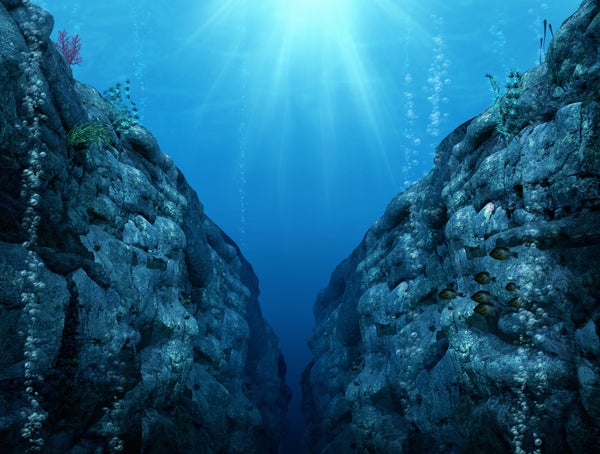

Somewhere between Hawaii and the Philippines near the small island of Guam, far below the surface of the water, sits the Mariana Trench, the deepest spot in the ocean. What’s down there?
How deep is the Mariana Trench?
The Trench sits like a crescent-shaped dent in the floor of the Pacific Ocean, extending over 1500 miles long with an average width around 43 miles and a depth of almost 7 miles (or just under 36,201 feet). At that depth, the weight of all that water above makes the pressure in the Trench around 1000 times higher than it would be in, say, Miami or New York. Floor vents release bubbles of liquid sulfur and carbon dioxide. Temperatures are just above freezing, and everything is drowning in darkness.
For comparison, most ocean life lives above a depth of 660 feet. Nuclear submarines hover around 850 feet below the surface as they travel through the ocean waters. Whales aren’t usually seen below about 8,200 feet. The site of Jack and Rose’s true (albeit fictional) love, the sunken Titanic, can be found at 12,467 feet.
According to National Geographic, if you were to put Mount Everest at the bottom of the Mariana Trench, its peak would still sit around 7,000 feet below sea level.
Toward the southern end of the Mariana Trench lies the Challenger Deep. It sits 36,070 feet below sea level, making it the point most distant from the water’s surface and the deepest part of the Trench.
While the number of people that have climbed to the top of Mount Everest, the Earth’s highest point, holds somewhere in the thousands, only 3 divers have ever explored the Challenger Deep. The first expedition happened in 1960 when Jacques Piccard and Navy Lt. Don Walsh reached the Challenger Deep in a U.S. Navy submersible. They were only able to spend 20 minutes there due to the extreme pressures, and their arrival stirred up too much dust from the seafloor for them to take any pictures.
The next visitor didn’t arrive until over 50 years later in 2012, when filmmaker and science fiction aficionado James Cameron solo dived to the Challenger Deep in a submarine he designed himself. Cameron was able to spend three hours there. And, of course, he captured video and took many photos—he is a Hollywood filmmaker, after all.
The extreme pressures took a toll on his equipment, though. Batteries drained, sonar died, and some of his vessel’s thrusters to malfunctioned, making it hard to maneuver.
»Continue reading “The Mariana Trench is 7 Miles Deep—What’s Down There?” on QuickAndDirtyTips.com