
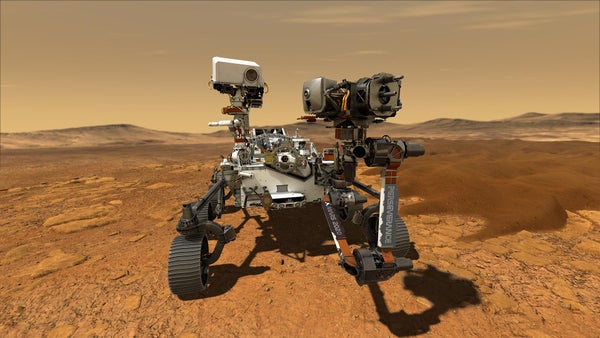
Three years ago, I received an e-mail from a 10-year-old girl I'll call Ann, from Brazil, my native country, asking me several questions. Is there life on Mars? Do you control theCuriosity [rover]? Does NASA have a lot of technology? Do you work with research? Do you know many scientists? Do you know the president of the United States?
I was so pleased to see a girl asking me these questions, since that I would also have been fascinated by rovers on Mars at her age. I grew up admiring NASA’s missions to explore the solar system and wondered how they were able to send photos back to Earth from millions of miles away. I was the only girl I knew who had a favorite spaceship, and those missions were the reason I decided to become an astronomer.
I knew I had to meet that curious little girl so I wrote back to her teacher and scheduled to visit them in Rio de Janeiro at Redes da Maré, a nonprofit organization designed to increase the quality of life for local residents, including through additional educational opportunities. I had visited Redes da Maré before as part of my own outreach program to trigger kids' curiosity by telling them about the discoveries of the Hubble Space Telescope. This time, I brought a few meteorites to teach them about the solar system. I showed them how it’s interconnected because it formed out of the same enormous cloud of gas and dust. We talked about life on other planets, and about the fact that they were touching a rock from space. The girl who had written to me took her role as guardian of the meteorites during the lecture seriously, knowing how special the specimens were.
On supporting science journalism
If you're enjoying this article, consider supporting our award-winning journalism by subscribing. By purchasing a subscription you are helping to ensure the future of impactful stories about the discoveries and ideas shaping our world today.
While I was there, I kept thinking how surreal the situation was. I traveled from the United States to meet a 10-year-old girl who was surrounded by poverty but who knew there were rovers on Mars. I met her again last year during the filming of a documentary on empowering women at the same Redes da Maré. But the 12-year-old was not as fascinated by rovers as the 10-year-old was. She asked me about music and if I knew K-pop, her favorite genre. I asked her how she was doing in school and she confessed that she didn’t like her math teacher in the public school. She had left Redes because she was now living far away with her aunt. She came that day just to see me.
Honestly, I don’t know if she will be able to have a career in science. The odds are very, very low. At this point, finishing school would be an impressive achievement. Many girls like her don’t. They drop out of school, they feel unsafe and don’t have the same opportunities as boys to explore possibilities.
But how do we make sure girls embrace science as a possible and safe career path? How do we make sure we do a better job to nurture young girls’ interest in science? I don’t have a magic formula for this, but I do know you can’t be what you can’t see. If little girls don’t see women scientists, they will not see themselves in those roles. At age 10, that little girl could see me, a female scientist, as someone who could maneuver the rover on Mars. But what happens during teenage years that change their perception?
Life-changing events will pull them in many directions, and we need to make sure their curiosity about science doesn't fade with age. We must empower them with quality education to keep them engaged with science. We must keep them curious during their journey to adulthood and help them envision science as a career. And we must help them see themselves as agents of change to transform the world for the better. Maybe then we will be able to attract more girls into science.
When I heard that NASA’s new rover Perseverance, scheduled for launch in just a few weeks, named by a seventh grader named Alexander Mather, I thought about writing to the now 12-year-old girl. In my letter, I would talk not only about Perseverance, but also about the practice of perseverance. It doesn’t matter if she is not able to have a career in science and she chooses something else. What matters is that day after day, we need to find strength to keep our dreams alive, and education can make your dreams come true. As Mather said in his winning essay, “We as humans evolved as creatures who could learn to adapt to any situation” and “The human race will always persevere into the future.” He is right.
Imagine how many girls and boys were touched by the possibility of winning the NASA competition of naming the rover. Then imagine how many went beyond that and dreamed of maneuvering the rover on another planet. When a little girl of the future asks me if I control the Perseverance, I will tell her I don’t, but I will make sure I tell her how much a little girl I once knew had to persevere in her life, and how her curiosity drove her to dream of maneuvering a rover on another planet.