
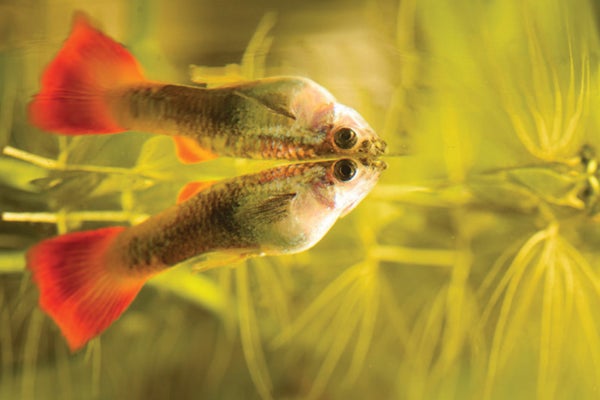
Guppies make unassuming pets, but in the wild they adopt a daring and counterintuitive tactic to avoid becoming dinner. When they spot a predator, they suddenly darken their eyes from silver to jet black—enticing the attacker to go straight for the guppy's head.
In a paper published in July in Current Biology, researchers report that this seemingly bizarre behavior may be a diversion that helps guppies dodge would-be hunters.
Robert Heathcote, a behavioral ecologist at the University of Exeter in England, says he came up with this hypothesis while eating a blueberry muffin on a train. He had noticed in high-speed videos that ambush predator fish called pike cichlids seemed to aim their attacks at the heads of the guppies with black eyes. “The guppy would wait right until the last minute and then kind of reverse itself and dodge out of the way,” says Heathcote, the study's lead author.
On supporting science journalism
If you're enjoying this article, consider supporting our award-winning journalism by subscribing. By purchasing a subscription you are helping to ensure the future of impactful stories about the discoveries and ideas shaping our world today.
To test how pike cichlids respond to black- versus silver-eyed guppies, Heathcote first tried using colored contact lenses, iPad videos and even tattooing the eye of a dead fish—but found the needle could not pierce the surprisingly tough eye surface. Eventually Heathcote and his colleagues built robotic guppies, pulled by fishing line, to test their hypothesis. The cichlids targeted the heads of black-eyed fakes but the bodies of silver-eyed ones.
Another experiment, with live guppies protected by a transparent barrier, revealed how the guppies rapidly swung their heads away to flee from oncoming predators' maws with an innate “fast-start” escape reflex. Pike cichlid attacks are ballistic and do not deviate from their course once launched, so the researchers could “simulate” whether a guppy would have escaped without the barrier's intervention.
Larger guppies, which are typically less agile and easier to catch, benefited the most from this matadorlike strategy. “It's this misdirection,” says senior author Darren Croft, also at Exeter. “By doing that, they can pivot the head away and escape.”
These guppies may not be the only prey animals using such a strategy. Other fish also change their eyes' tint, and species including epaulette sharks and rock doves have attention-grabbing color patterns on their backs.
“This [study] opens a whole new area of research, and it might explain cases where eyes or eyespots are very conspicuous,” says Karin Kjernsmo, a behavioral and evolutionary ecologist at the University of Bristol in England, who was not involved in the study. “Maybe together with an evasive strategy, [these results] could explain why that is so.”
In an eat-or-be-eaten world, there is always more than meets the eye.