
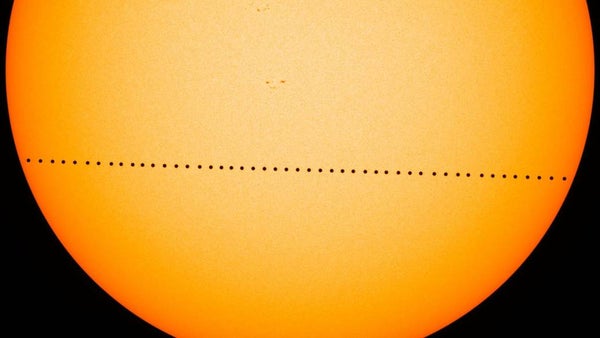
Grab your solar eclipse glasses or protected astronomical equipment, because Mercury is marching across the sun as we speak.
The closest planet to the sun began its transit—an apparent passage across the sun from the perspective of Earth—at 7:35 a.m. EST (1235 GMT) and will continue its journey for 5.5 hours. It will be visible in the U.S.and many other parts of the world. Be sure to check this event out, as it will be the last time until 2032 that Mercury transits the sun. And that occurrence won’t be visible in the U.S.; Americans will have to wait until 2049 for the next visible event.
You can watch the Mercury transit of 2019 live here, courtesy of Slooh.com. You can also watch the Slooh webcast directly here on YouTube.
On supporting science journalism
If you're enjoying this article, consider supporting our award-winning journalism by subscribing. By purchasing a subscription you are helping to ensure the future of impactful stories about the discoveries and ideas shaping our world today.
Mercury made first contact (when its disk was externally tangent to the sun) at 7:35 a.m. EST (1235 GMT), just past sunrise on the U.S. East Coast. Its second contact—when the disk appeared in full silhouette on the sun, took place two minutes later, at 7:37 a.m. EST (1237 GMT). This included a brief “black drop effect” (or black teardrop shape) that made Mercury appear to connect to the solar disk edge. This effect happens due to imperfections in telescope optics.
Coming up later today will be third contact (1:02 p.m. EST, 1802 GMT), when you can see the black drop effect again. Mercury will be at the other edge of the sun and starting to exit. The transit will complete at 1:04 p.m. EST (1804 GMT) when Mercury exits the sun and completes fourth contact.
You can easily watch the event safely online on channels such as Slooh or the Virtual Telescope, or through a feed from NASA’s Solar Dynamics Observatory spacecraft.
Mercury is too small to spot with the naked eye, but you can watch it yourself with a telescope or a pair of binoculars as long as they are equipped with proper solar protection. (Never look at the sun, even briefly, without protecting your eyes and equipment.) You can also go to a local astronomy club or event that has similarly equipped telescopes or binoculars.
This will be the fourth time this century (out of 14 occasions) that Mercury will cross the sun from Earth’s perspective. Transits of Mercury are relatively rare because usually, when the planet is near the sun from Earth’s perspective, it is slightly “out of plane”—meaning that it passes above or below the sun. Occasionally, however, the planets and the sun all line up in the sky and it’s possible to see Mercury transiting across the face of our star. Scientists are taking advantage of the opportunity to perform some science related to studying Mercury’s tenuous atmosphere, while citizen scientists have some projects of their own.
Copyright 2019 Space.com, a Future company. All rights reserved. This material may not be published, broadcast, rewritten or redistributed.