The Most Confused of the Scientific Branches

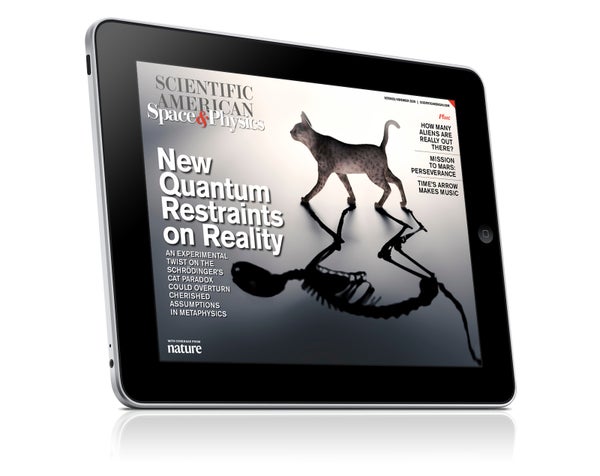
An experimental twist on the Schrödinger’s cat paradox could overturn cherished assumptions in metaphysics

Scientific American Space & Physics October 2020

Scientific American Space & Physics October 2020

Join Our Community of Science Lovers!

Quantum researchers seem to have more theories than they know what to do with. Of the handful of options, take, for example, the many-worlds view, which posits that when a quantum observation is made, reality splits into parallel universes, each representing all potential outcomes. Or there is the relatively new QBism camp, members of which argue that quantum mechanics is subjective to the individuals making predictions about how they will measure an experiment. On top of these conflicting theories, any new experimental data invariably support one possible explanation and contradict another. What to make of this confounding research situation? Where some see an impasse, others see opportunity. At the very end of this issue’s cover story, Michele Reilly, co-founder of a quantum computing company based in New York City, tells our reporter that such confusion opens the door for novel experiments, of both the theoretical variety and the physical (see “This Twist on Schrödinger’s Cat Paradox Has Major Implications for Quantum Theory”). If that’s not a pure emblem of the scientific method, then I don’t know what is.

Elsewhere in this issue, Anil Ananthaswamy examines the latest estimates of alien life in the universe—estimates that ride on 18th-century statistics (see “How Many Aliens Are in the Milky Way? Astronomers Turn to Statistics for Answers”). And Alexandra Witze gives a dazzling overview of NASA’s latest rover project: Perseverance (see “NASA Has Launched the Most Ambitious Mars Rover Ever Built: Here’s What Happens Next”). If any field needed the gumption to keep going for the long haul, it’s space and physics. Enjoy!

Andrea Gawrylewski is chief newsletter editor at Scientific American. She writes the daily Today in Science newsletter and oversees all other newsletters at the magazine. In addition, she manages all special editions and in the past was the editor for Scientific American Mind, Scientific American Space & Physics and Scientific American Health & Medicine. Gawrylewski got her start in journalism at the Scientist magazine, where she was a features writer and editor for "hot" research papers in the life sciences. She spent more than six years in educational publishing, editing books for higher education in biology, environmental science and nutrition. She holds a master's degree in earth science and a master's degree in journalism, both from Columbia University, home of the Pulitzer Prize.

More by Andrea Gawrylewski
SA Space & Physics Vol 3 Issue 5This article was published with the title “The Most Confused of the Scientific Branches” in SA Space & Physics Vol. 3 No. 5 ()
doi:10.1038/scientificamerican102020-411e1wJjUnsIcC3VgNIziX

It’s Time to Stand Up for Science

If you enjoyed this article, I’d like to ask for your support. Scientific American has served as an advocate for science and industry for 180 years, and right now may be the most critical moment in that two-century history.

I’ve been a Scientific American subscriber since I was 12 years old, and it helped shape the way I look at the world. SciAm always educates and delights me, and inspires a sense of awe for our vast, beautiful universe. I hope it does that for you, too.

If you subscribe to Scientific American, you help ensure that our coverage is centered on meaningful research and discovery; that we have the resources to report on the decisions that threaten labs across the U.S.; and that we support both budding and working scientists at a time when the value of science itself too often goes unrecognized.

In return, you get essential news, captivating podcasts, brilliant infographics, can't-miss newsletters, must-watch videos, challenging games, and the science world's best writing and reporting. You can even gift someone a subscription.

There has never been a more important time for us to stand up and show why science matters. I hope you’ll support us in that mission.

Thank you,

David M. Ewalt, Editor in Chief, Scientific American

Subscribe