
Seen through the eyes of some omnipotent time traveler, our solar system—like any planetary system—is a heaving, pulsing thing. Across millions and billions of years its contents ebb and flow. Planetary orbits shift in shape and orientation, and billions of ancient asteroidal pieces shuffle through the skeletal disk that defines the major architecture of all that surrounds the sun, itself a star that sheds mass and energy as it gradually climbs an-ever brightening staircase of thermonuclear fusion.
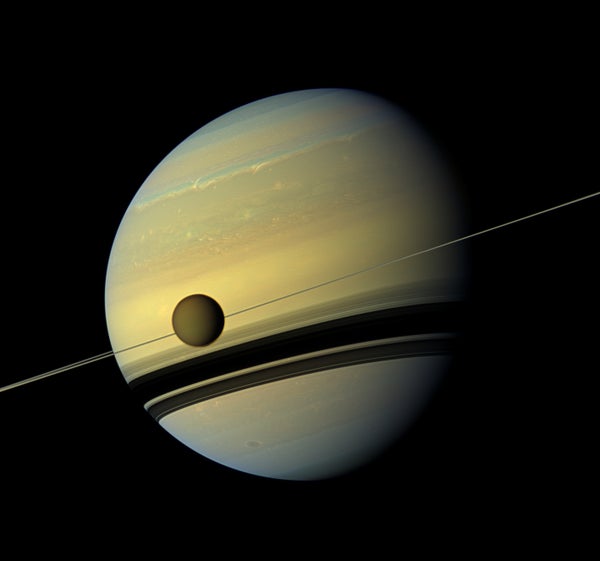
But some things are assumed to be comparatively dull and unchanging. Saturn’s largest moon, Titan, for instance, was expected to sit in its orbit with little alteration to that position over the billions of years since its formation. Now a study published in Nature Astronomy by Lainey, et al., has used measurements from the Cassini spacecraft (which orbited Saturn from 2004 to 2017) to determine that Titan has an orbit that grows by an astonishing 11 centimeters each year.
The solution the authors propose to this new mystery rests in an intricate but powerful phenomenon that, if they are correct, could help us understand the grander history of moons around all giant worlds. To understand that, we have to step back and look at the slow changes across our solar system that are due to the complex dissipations of tides—where energy of motion is almost magically transferred into the stretching and grinding of raw materials, from rock and iron, to water and gas. Our own Earth and moon have been doing this for four billion years. The moon’s gravity pulls the spinning Earth into a distorted shape and that movement of mass in turn tugs on the moon, raising its orbit ever higher, at a rate that today amounts to a growth in distance of nearly four centimeters a year, and a corresponding spin-down of Earth’s day length by some 23 microseconds a year.
On supporting science journalism
If you're enjoying this article, consider supporting our award-winning journalism by subscribing. By purchasing a subscription you are helping to ensure the future of impactful stories about the discoveries and ideas shaping our world today.
But those rates of change are intimately connected to Earth’s structure—the location of its continents, the depths and flows of its oceans, and the material composition of its rocky layers. It’s a strange thing, but if all you knew of the Earth and moon was their orbital evolution across the eons you could still learn about Earth’s fundamental construction.
In the outer solar system, the environment for natural satellites gets more complicated and interesting, with families of moons around worlds like Jupiter and Saturn that feel both the tidal interaction with their host worlds and the persistent gravitational tug of their sister moons. But we’ve mostly assumed that it’s very hard for moons to raise significant tides on giant planets, especially when, like Titan, those moons orbit at a considerable distance.
Titan’s 11-centimeter-a-year orbital expansion indicates that Saturn has to be “responding” to Titan’s gravitational pull far, far more than we might have expected. More specifically, the critical measure of how much energy is being dissipated by Titan-Saturn tides is more than 100 times larger than standard theory would predict (and possibly even 1,000 or 10,000 times larger).
So, what’s going on? The answer may be a phenomenon broadly characterized as resonance-locking tidal theory. In essence, if the internals of a planet like Saturn get “strummed” at the right frequency by the gravitational pull of a moon there’s an amplification of the tidal distortion—a kind of natural ringing, or resonance, of the thick gaseous envelope of the planet, and consequently more powerful gravitational interaction with the moon that’s doing the strumming. And because the internal structure of a gas giant evolves over billions of years (because of things like gravitational contraction and helium rain) these resonances will change over time, sometimes “locking” onto different moons’ orbital period and driving unexpectedly fast alterations in their orbits.
Lainey, et al., also follow up earlier studies of other large moons around Saturn, such as Enceladus and Dione, and find that for these too the rate of orbital change is pretty well matched by resonance-locking. The upshot is that all of Saturn’s large moons were likely originally in a much more compact configuration, and they’ve all been driven outwards over the past 4.5 billion years by resonance tides. That includes Titan, which in classical (so-called) equilibrium tidal theory, should have basically not budged from its original orbit. Instead this moon may have drifted outwards from an original formation orbit that was three to four times smaller.
It’s a fantastic reminder that nature is often full of much greater richness than we at first suspect. This result also implies that similar effects might be in play for Jupiter and its major moons—both adding insight to how those moons formed and what we might learn about the inner workings of gas giants in general. Further afield, this discovery has implications for exomoon populations, binary stars and even for cases where close-orbiting planets are raising tides in their parent stars.