
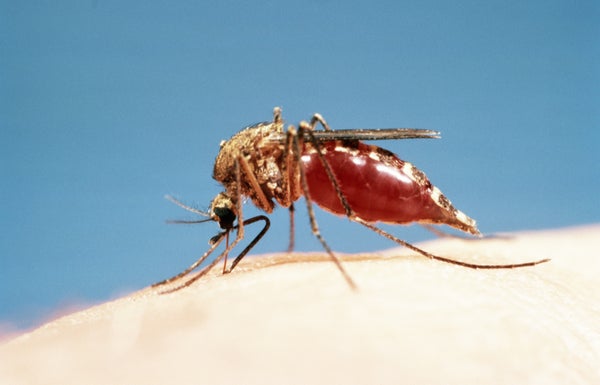
Mosquitoes are the world's deadliest animals, transmitting diseases that kill hundreds of thousands of people annually. Only the females bite, to acquire protein to make their eggs. But blood can also serve as a refreshing beverage on a hot, dry day.
A new study finds that dehydrated mosquitoes are more aggressive, land more often on hosts and feed more frequently than those with ready access to water. In quenching their thirst, they may also increase the spread of disease, says Joshua Benoit, a biologist at the University of Cincinnati and senior author of the study, published in May in Scientific Reports.
Because some mosquitoes lay their eggs on water, researchers have long assumed that wetter conditions lead to more mosquito-borne illness. Yet recent studies have hinted at the opposite, linking increased transmission of diseases such as West Nile fever to droughts. Benoit and his colleagues' discovery helps to resolve these counterintuitive findings.
On supporting science journalism
If you're enjoying this article, consider supporting our award-winning journalism by subscribing. By purchasing a subscription you are helping to ensure the future of impactful stories about the discoveries and ideas shaping our world today.
“It's not just as simple as saying, ‘If it's wet, there will be more mosquitoes and more disease transmission,’” Benoit says.

Credit: Amanda Montañez; Source: “Dehydration Prompts Increased Activity and Blood Feeding by Mosquitoes,” by Richard W. Hagan et al., in Scientific Reports, Vol. 8, Article No. 6804; May 1, 2018
His laboratory became interested in the impact of dehydration on mosquito-feeding behavior by accident: a worker dropped a container of water-deprived mosquitoes and noticed that they dive-bombed him with much greater vigor than usual.
The researchers studied three mosquito species that transmit yellow fever, Zika or West Nile fever. They exposed hundreds of insects to different temperatures and humidity levels in cages with or without access to water and nectar (mosquitoes' preferred sugar source). They then tested how often the pests chose to bite a “host”: a warm, waxy plastic membrane coated in artificial sweat and filled with chicken blood.
Within a few hours up to 30 percent of mosquitoes without water fed on their host's blood—compared with 5 to 10 percent of those that had water. “Even short periods of dehydration can have profound effects,” Benoit says.
These “very interesting” findings have real-world applications for predicting rates of disease transmission, says Chloe Lahondere, an entomologist at Virginia Tech, who was not involved in the study: “To develop new tools to efficiently fight these insects, it is essential to have a better understanding of their biology.”