
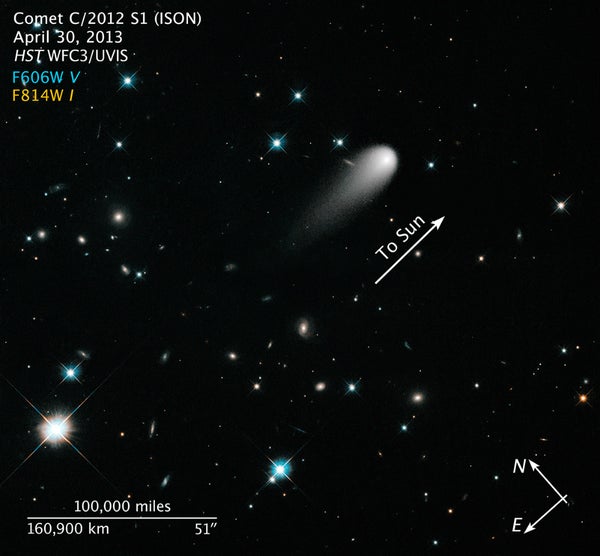
Comet ISON races toward the inner solar system across a backdrop of stars and galaxies in this image taken by the Hubble Space Telescope on April 30, 2013.
As the comet plummets toward the sun, its icy nucleus warms up. Plumes of gas blow off the surface and carry away microscopic dust particles—more than 200 million kilograms every day. Freed from the comet’s feeble gravity the gas and dust trail behind, stretching into a tail currently long enough to wrap around Earth seven times. The nucleus, however, is only about five kilometers across—it would comfortably fit within a small town.
Seen from 600 million kilometers away, the comet is scheduled to pass within two million kilometers of the sun on November 28—about 16 times closer than Mercury. At the time of this picture, Comet ISON was somewhere between Jupiter and the Asteroid Belt.
On supporting science journalism
If you're enjoying this article, consider supporting our award-winning journalism by subscribing. By purchasing a subscription you are helping to ensure the future of impactful stories about the discoveries and ideas shaping our world today.
Discovered in 2012 at the International Scientific Optic Network in Russia, Comet ISON (named for the network’s acronym) is thought to be paying its first visit to the inner solar system from the distant Oort Cloud, a haze of ice chunks well beyond Pluto. Astronomers estimate that the cloud may extend out another light-year—nearly one quarter the distance to the closest star. Both the Oort Cloud and the closer Kuiper Belt—just outside the orbit of Neptune—are filled with icy debris left over from the formation of the planets. Every so often something shakes one of these dirty snowballs loose and sends it careening toward the sun. Each comet carries with it a history of our solar system and teaches astronomers something new about where we came from.
—Christopher Crockett