The Power of the Headline

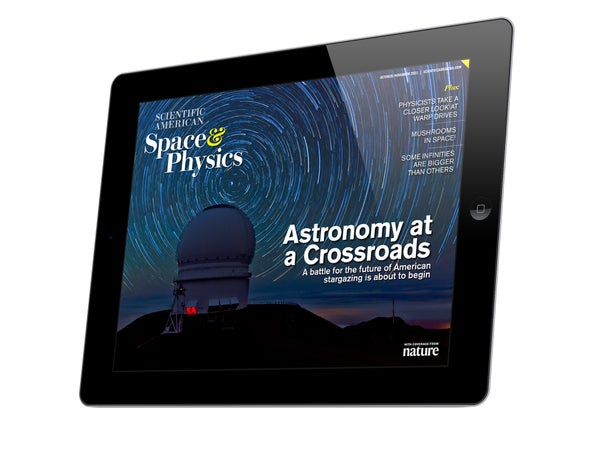
Scientific American Space & Physics, October 2021

Scientific American Space & Physics, October 2021

Join Our Community of Science Lovers!

When news journalists write headlines, they brainstorm the most succinct, compelling encapsulation—the takehome message—for their articles. This is much trickier than it sounds, as certain phrasings might misrepresent a story’s essence or omit important elements. In this collection, senior space editor Lee Billings does an in-depth analysis of what might be included in the decadal astronomy report, set to be released any moment by the U.S. National Academies of Science, Engineering, and Medicine. It will help set the national priorities for astronomical research and budgeting for the next decade and beyond, as our article’s title indicates (see “This Report Could Make or Break the Next 30 Years of U.S. Astronomy”).

As I read Billings’s article, I couldn’t help but be reminded of headline writing. As John O’Meara, chief scientist of the W. M. Keck Observatory on Mauna Kea in Hawaii, astutely tells Billings, to get public buy-in for space funding, the decadal report would do well to come up with a single mission objective for people to rally around— “What causes life in the universe?” for example. No small feat considering the many stakeholders and interests at the table, not to mention the myriad questions astronomers are hoping to answer in the coming years. As we say in journalism, a strong headline can be what determines if anyone reads your article at all. Apparently the near future of cosmology may hinge on a winning banner statement, too. We’ll soon see how well the decadal report authors do.

Andrea Gawrylewski is chief newsletter editor at Scientific American. She writes the daily Today in Science newsletter and oversees all other newsletters at the magazine. In addition, she manages all special editions and in the past was the editor for Scientific American Mind, Scientific American Space & Physics and Scientific American Health & Medicine. Gawrylewski got her start in journalism at the Scientist magazine, where she was a features writer and editor for "hot" research papers in the life sciences. She spent more than six years in educational publishing, editing books for higher education in biology, environmental science and nutrition. She holds a master's degree in earth science and a master's degree in journalism, both from Columbia University, home of the Pulitzer Prize.

More by Andrea Gawrylewski
SA Space & Physics Vol 4 Issue 5This article was published with the title “The Power of the Headline” in SA Space & Physics Vol. 4 No. 5 ()
doi:10.1038/scientificamerican102021-4fWRYc86e5PfkzfBmza8ld

It’s Time to Stand Up for Science

If you enjoyed this article, I’d like to ask for your support. Scientific American has served as an advocate for science and industry for 180 years, and right now may be the most critical moment in that two-century history.

I’ve been a Scientific American subscriber since I was 12 years old, and it helped shape the way I look at the world. SciAm always educates and delights me, and inspires a sense of awe for our vast, beautiful universe. I hope it does that for you, too.

If you subscribe to Scientific American, you help ensure that our coverage is centered on meaningful research and discovery; that we have the resources to report on the decisions that threaten labs across the U.S.; and that we support both budding and working scientists at a time when the value of science itself too often goes unrecognized.

In return, you get essential news, captivating podcasts, brilliant infographics, can't-miss newsletters, must-watch videos, challenging games, and the science world's best writing and reporting. You can even gift someone a subscription.

There has never been a more important time for us to stand up and show why science matters. I hope you’ll support us in that mission.

Thank you,

David M. Ewalt, Editor in Chief, Scientific American

Subscribe