The Quiet after the Storm

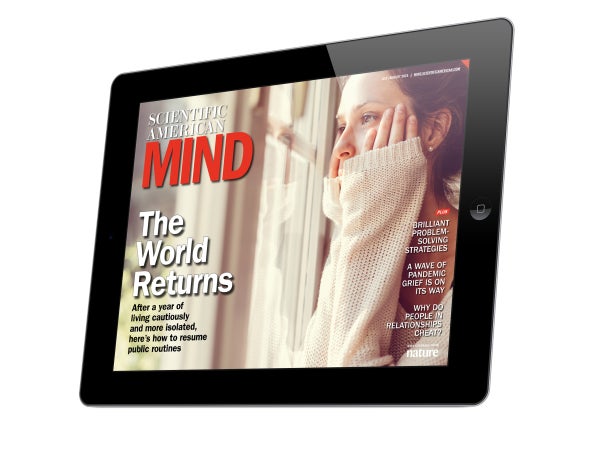
After a year of living cautiously and more isolated, here’s how to resume public routines

Girl looking pensive through the window with hands on cheek.

Scientific American MIND, July 2021; Getty Images

Join Our Community of Science Lovers!

In mid-May the Centers for Disease Control and Prevention released new guidelines stating that fully vaccinated people were not required to wear masks in most settings, including indoors at restaurants and in other public spaces. The decision was soundly rooted in science, although it felt jarring to many—even those of us writing and reporting about COVID-19 on a daily basis. After more than a year of masks and social distancing, the idea of overnight returning to mostly normal was a shock to the system. We were not alone. A substantial number of individuals recently told researchers with the American Psychological Association that they were hesitant to resume to their old ways of life despite being vaccinated, as Melba Newsome reports in this issue’s cover story (see “‘Cave Syndrome’ Keeps the Vaccinated in Social Isolation”). Personally, trusting the science and the effectiveness of the vaccines, in terms of both preventing severe disease (even from variants) and transmitting the virus to others, has given me the comfort to get back out there.

For those of us lucky enough to live in a country where case numbers keep declining, the aftereffects of the pandemic are coming into focus. After nearly 600,000 have died, millions in the U.S. have lost a loved one, and the grief has only just begun to set in (see “Covid Has Put the World at Risk of Prolonged Grief Disorder”). For those of us looking to finally walk out the door and face the world and for people coming to terms with the devastation of loss, time and self-compassion are in order.

Andrea Gawrylewski is chief newsletter editor at Scientific American. She writes the daily Today in Science newsletter and oversees all other newsletters at the magazine. In addition, she manages all special editions and in the past was the editor for Scientific American Mind, Scientific American Space & Physics and Scientific American Health & Medicine. Gawrylewski got her start in journalism at the Scientist magazine, where she was a features writer and editor for "hot" research papers in the life sciences. She spent more than six years in educational publishing, editing books for higher education in biology, environmental science and nutrition. She holds a master's degree in earth science and a master's degree in journalism, both from Columbia University, home of the Pulitzer Prize.

More by Andrea Gawrylewski
SA Mind Vol 32 Issue 4This article was published with the title “The Quiet after the Storm” in SA Mind Vol. 32 No. 4 (), p. 2
doi:10.1038/scientificamericanmind0821-2

It’s Time to Stand Up for Science

If you enjoyed this article, I’d like to ask for your support. Scientific American has served as an advocate for science and industry for 180 years, and right now may be the most critical moment in that two-century history.

I’ve been a Scientific American subscriber since I was 12 years old, and it helped shape the way I look at the world. SciAm always educates and delights me, and inspires a sense of awe for our vast, beautiful universe. I hope it does that for you, too.

If you subscribe to Scientific American, you help ensure that our coverage is centered on meaningful research and discovery; that we have the resources to report on the decisions that threaten labs across the U.S.; and that we support both budding and working scientists at a time when the value of science itself too often goes unrecognized.

In return, you get essential news, captivating podcasts, brilliant infographics, can't-miss newsletters, must-watch videos, challenging games, and the science world's best writing and reporting. You can even gift someone a subscription.

There has never been a more important time for us to stand up and show why science matters. I hope you’ll support us in that mission.

Thank you,

David M. Ewalt, Editor in Chief, Scientific American

Subscribe