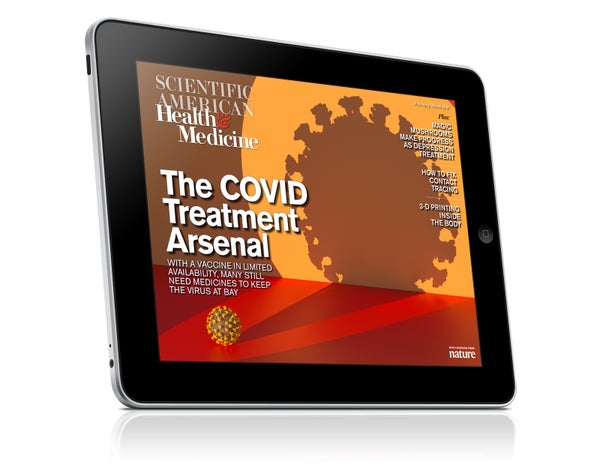
Scientific American Health & Medicine February 2021
Join Our Community of Science Lovers!
On supporting science journalism
If you're enjoying this article, consider supporting our award-winning journalism by subscribing. By purchasing a subscription you are helping to ensure the future of impactful stories about the discoveries and ideas shaping our world today.
I’m sure I wasn’t alone when I breathed a sigh of relief at the much ballyhooed arrival of COVID-19 vaccines at the end of 2020. We’re in the midst of a dark and grief-stricken pandemic winter, and the sooner the vaccine gets us to herd immunity—and, pray, a semblance of normalcy—the better. But the well-worn trope that life is a journey, and not a destination, has an epidemiological application as well. As of this writing, the U.S. just suffered a record-breaking day of thousands of fatalities caused by the novel coronavirus. So in the interim months while most Americans wait their chance to be vaccinated, our goal certainly must be to minimize deaths from COVID-19. In this issue’s cover story, Charles Schmidt takes a comprehensive look at the latest developments in clinical treatments for COVID-19 infection, many of which still need research to bolster their effectiveness (see “These Drugs Might Prevent Severe COVID”).
Elsewhere on the virus beat, restrictions that have been implemented to combat the coronavirus are having a drastic impact on flu and cold rates across the globe, offering up some telling evidence for public health researchers (see “How COVID-19 Is Changing the Cold and Flu Season”). The science of viruses and human illness is ever evolving. In the case of the global pandemic, the question isn’t when will we arrive at the end but how.
Subscribe to Support Independent Journalism
Great science journalism requires human expertise, time, effort and creativity. And it costs money. That’s why I and the journalists here at Scientific American hope you’ll join our community.
When you subscribe, you are supporting staff and freelance journalists who are passionate about telling science stories that are true, important and compelling. Our editors and reporters are often experts in their fields, which means they understand the nuances of big discoveries and can untangle the breakthroughs from the hype. With a subscription, you are also supporting rigorous fact-checking to ensure the words we publish are precise and accurate. And you’re supporting original illustrations, graphics and photos that bring you closer to an advanced laboratory, an ice sheet in Antarctica or a space mission in orbit. You’re helping us craft other types of high-quality journalism as well: Our newsletters are carefully written, edited and curated by staffers you have or will come to know and love. Our Science Quickly podcast is based on original reporting, collaboration with editors and scientists and exacting production.
Subscriptions keep this engine running so we can continue to deliver thoughtful, rigorous and independent science journalism to you. In an era of viral misinformation, this work is crucial. If you value what we do, I hope you’ll consider joining us as a subscriber
Thank you,
Jeanna Bryner, Editor in Chief, Scientific American