
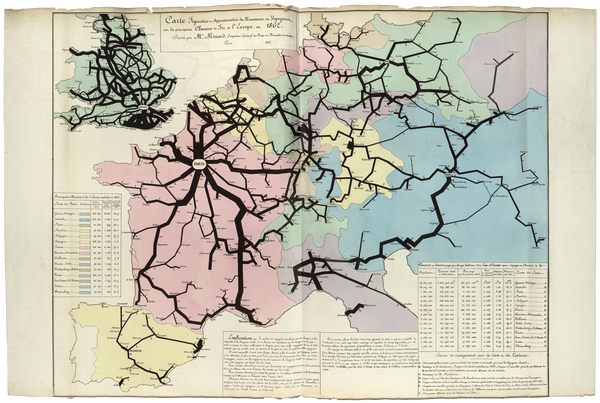
The Minard System: The Complete Statistical Graphics of Charles-Joseph Minard
by Sandra Rendgen.
Princeton Architectural Press, 2018 ($60).
French civil engineer Charles-Joseph Minard became famous in the 19th century for the “flow map,” which represents the movement and quantity of something over space or time. His most recognized map was among his last: the charting of Napoleon’s disastrous 1812 campaign into Russia, in which hundreds of thousands of troops were lost. A forefather of modern information visualization, as writer and editor Rendgen calls him, Minard created more than 60 statistical graphics that capture the economic and social changes of the industrial revolution in Europe and around the globe. He meticulously interpreted the data for each topic and created a narrative intended to shine through each map. This stunning collection includes them all—from visual depictions of the transport of mineral fuels in France in 1856 to a series on the European import of cotton over eight years. The flow map above shows the number of railroad passengers in Europe in 1862.
The Eating Instinct: Food Culture, Body Image, and Guilt in America
by Virginia Sole-Smith.
Henry Holt, 2018 ($28).
On supporting science journalism
If you're enjoying this article, consider supporting our award-winning journalism by subscribing. By purchasing a subscription you are helping to ensure the future of impactful stories about the discoveries and ideas shaping our world today.
When journalist Sole-Smith’s daughter was an infant, she had to be tube-fed because of a heart surgery. After her recovery, she refused to drink milk and, later, to eat solid food. It took two years for the author and her husband to painstakingly teach their child to feel safe and interested in eating. Although their example is extreme, Sole-Smith investigates the varied ways many people’s relationships with food are fraught. In this engrossing tale, she interviews doctors, nutritionists, chefs and many individuals who are all striving to figure out what it means to “eat well.” Sole-Smith reveals the lack of science behind many diets and detox plans claiming to improve health and wonders, “Why is it so hard to feel good about food?” —Clara Moskowitz
Suicidal: Why We Kill Ourselves
by Jesse Bering.
University of Chicago Press, 2018 ($27.50)
By age 35 psychologist and writer Bering had accomplished most of his career ambitions. He was respected in academia, having scored large research grants and published in prestigious journals. He also was a successful freelance writer. Outwardly he seemed to be thriving, but internally he suffered from suicidal thoughts. Why do people in their prime have the impulse to kill themselves? Bering takes us through the science behind ending one’s life. Bering says research shows, for instance, that susceptibility to suicide is about 43 percent dependent on genetics and 57 percent on environmental factors. He weaves together personal stories, delves into whether nonhuman animals die by suicide, and examines the relation of religion and self-killing. These angles offer a critical perspective on a devastating problem. —Sunya Bhutta
Gene Machine: The Race to Decipher the Secrets of the Ribosome
by Venki Ramakrishnan.
Basic Books, 2018 ($18.99).
Many people know what DNA is and how it works. Most, however, would struggle to describe the ribosome, the molecular machine that synthesizes proteins according to the genetic code. “Virtually every molecule in every cell in every form of life is either made by the ribosome or made by enzymes that are themselves made by the ribosome,” writes Ramakrishnan, co-winner of the 2009 Nobel Prize in Chemistry for illuminating the ribosome’s structure. As he relates in this absorbing account, his team raced others for decades to decipher the structure; its nonuniform crystal pattern does not lend itself to x-ray crystallography and defied years of coaxing. With each try, Ramakrishnan got a slightly clearer picture of this ancient machinery—paving the way for discoveries in antibiotics and other fields. —Kacper Ksieski
