
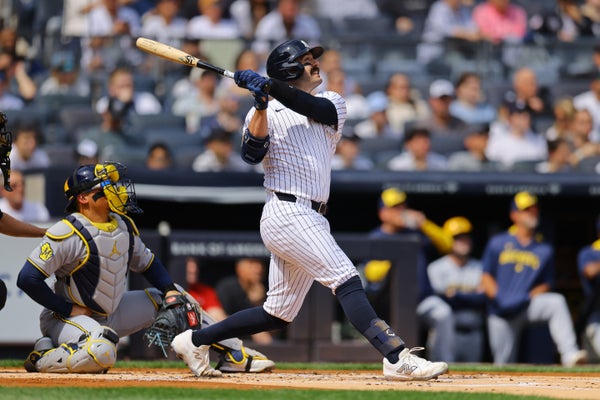
The New York Yankees’ 20-9 win against the Milwaukee Brewers last Saturday has put the spotlight on the odd, bowling-pin-shaped “torpedo bat” that many of the team’s players were swinging. The bat’s peculiar new design could help explain how the team achieved nine home runs that night.
Just what’s so special about this bat? Researchers say the design isn’t just about powering balls out of the park. Instead it’s a matter of accuracy and finesse, of letting players maneuver the bat better and turn foul balls into singles and pop flies into home runs.
“If there is a competitive advantage with the torpedo bat, it’s likely more due to an improved batting average than it is to an enhanced bat performance,” says Lloyd Smith, a professor of mechanical engineering at Washington State University, who studies bat performance.
On supporting science journalism
If you're enjoying this article, consider supporting our award-winning journalism by subscribing. By purchasing a subscription you are helping to ensure the future of impactful stories about the discoveries and ideas shaping our world today.
What that means is that the bat probably isn’t letting players smack the ball harder or faster. In fact, balls hit by the new torpedo bat may even go a bit slower on average, Smith says. But because of the shape, the bat feels easier to swing, and the ball is more likely to make contact with the bat’s thickest section, leading to a more solid hit.
A traditional baseball bat has a skinny handle that flares into a barrel of about the same diameter in the middle and far ends of the bat. The new torpedo bat moves the mass down toward the player’s grip, with a thicker barrel in the middle of the bat and a tapered end.
The key metric that this shift changes is something called swing weight, Smith says. When you swing a bat, it becomes a rotating object. That means that the weight that’s closest to your hands will be the easiest to move and that the weight that’s farthest away will be the hardest. A torpedo bat that weighs the same as a traditional one can thus feel lighter to swing. That means the batter can swing faster and make quicker split-second adjustments as the ball screams toward them.
“Because you’re able to swing the bat faster, you have a little longer to watch the ball before you commit,” Smith explains.
The design change for the torpedo bat also results in a bigger diameter at the middle of the barrel, making it more likely that players will hit the ball dead-on. “If you’ve got a bigger barrel, you’ve got a bigger chance of getting closer to the middle of the bat, so you’re likely to get a solid contact, a more direct hit,” says Daniel Russell, a teaching professor of acoustics at Pennsylvania State University, who also studies bats.
The Yankees used high-speed cameras to determine the spot where each player was most likely to hit the ball and then designed the bats to match. “These are things that are fine-tuned to the individual player, so there is a lot of room for innovation in this,” says Alan Nathan, an emeritus professor of physics at the University of Illinois Urbana-Champaign, who studies the physics of baseball.
What isn’t clear is if the new design lets players transfer energy more efficiently from bat to ball. That happens best at the region of a bat called its “sweet spot,” which is usually five to seven inches from its tip. The torpedo bat’s shape might change the sweet spot, Smith says, but if such bats end up lighter than traditional ones, the bat-ball collision might actually transfer less energy and lead to slightly slower ball speeds.
Another question involves the sensory experience of using the torpedo bat, Russell says. Its wider diameter could allow players to see the bat using peripheral vision, perhaps letting them line up their hits better. He, Nathan and Smith are all eager to test the new bat to answer such questions.
“We’re all set up for it,” Smith says. “We just need to get our hands on some of these bats.”