
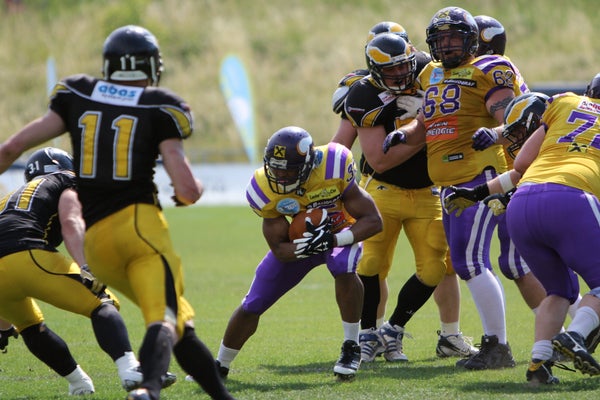
These days, a person can't talk about football without bringing up questions about the health effects of hard hits. Evidence is mounting that concussions experienced by players could lead to changes in the brain, including cognitive impairment.
But what about the bodily impacts football players experience?
In a new study, researchers at the University of Michigan set out to answer that question. They monitored 33 NCAA Division I football players using a device custom-fitted into the players' shoulder pads that had both a GPS receiver and an accelerometer. They measured the intensity and number of impacts, along with their distribution over the players' bodies. Then they sorted this data based on the players' positions.
On supporting science journalism
If you're enjoying this article, consider supporting our award-winning journalism by subscribing. By purchasing a subscription you are helping to ensure the future of impactful stories about the discoveries and ideas shaping our world today.
The impacts were measured in G-force. One G is equal to the force of Earth gravity, so 5 G's is five times the force of gravity. According to NASA, 3 G's is the amount of force it takes to pin people to the walls of spinning rides often seen at carnivals. A race car braking and turning is under about 5 G's of force, said Dennis K. Lieu, a professor of mechanical engineering at the University of California, Berkeley, in an email interview with Live Science. Lieu has spent about 20 years studying blunt trauma injury in sports; he was not involved in the new study. [5 Ways to Make Football Safer]
The researchers found the running backs in the study—the men generally tasked with carrying the ball—experienced more "severe" impacts (above 10 G's) than all other offensive positions, although not a statistically significant number more than quarterbacks, according to the findings published May 21 in the Journal of Strength and Conditioning Research. But at the same time, the running backs recorded fewer "heavy" impacts (7.1 to 8 G's) than either wide receivers or offensive linemen.
The researchers said that the severe impacts that running backs sustain could be the result of being tackled by multiple players while running at a high speed, or receiving a direct, head-on tackle from an opponent who is running at a high speed.
The wide receivers in the study experienced the most "very light" and "light to moderate impacts," among the offensive positions. These impacts ranged from a force of 5 to 6.5 G's. Offensive linemen also experienced significantly more very light impacts than either running backs or quarterbacks.
Among the defensive positions, defensive tackles experienced more moderate to very heavy (6.6 to 10 G's) hits than any other defensive position. The players in this position also recorded more light to moderate (6.1 to 6.5 G's) impacts than all other defensive positions. [10 Things You Didn't Know About the Brain]
This wide range of the forces of the hits that defensive tackles take is likely due to their high amount of physical contact with several opposing players during each play, the researchers wrote in their findings.
Defensive ends engaged in more severe impacts than any other defensive position, but the difference was not significant, according to the study.
Defensive backs and linebackers were subject to the most very light impacts (5 to 6 G's).
The study categorized the hits from very light to severe, but these labels don't signal potential for injury, Lieu said.
"At this time, there are no conclusions that have been drawn about any long-term health risks that may result from repeated exposures to such accelerations," he said. He noted, however, that the authors cited a 2012 study, co-authored by one of the same authors who did the new research, which found that impacts exceeding 7 G's were associated with decreases in neuromuscular performance after rugby competitions.
The ability to measure these impacts that players sustain could help determine when athletes should take a break, Erik Swartz, professor of kinesiology at the University of New Hampshire, told Live Science.
Swartz, who studies head injuries in football, said that these impacts recorded in the new study were much lower than what researchers have seen in head impacts. NFL research from 2003 showed that concussions occurred from impacts with an average linear acceleration of around 100 G's,.
These impacts are so much greater because they involve a smaller mass (the head), rotating around a fulcrum (the neck), as opposed to the more massive bodily hits this new research recorded, Swartz said.
Both Lieu and Swartz agreed that the data from the new study are high quality and unique, and could lay a foundation for future research. It would be difficult, however, to associate specific injuries with these general body impacts.
"You can't even start to try and conclude a cause and effect—that just because there's a 10 G collision, that's what led to an ACL rupture," Swartz said. "There's so much more involved in it than that."
In the paper, the authors suggested that position-specific data could lead to better monitoring and training for the different forces each player might experience. However, there needs to be more data collected and more players involved, they said.
Copyright 2016 LiveScience, a Purch company. All rights reserved. This material may not be published, broadcast, rewritten or redistributed.