The Science of Melting Chocolate

Researchers used an artificial tongue to understand how chocolate changes from a solid to a smooth emulsion

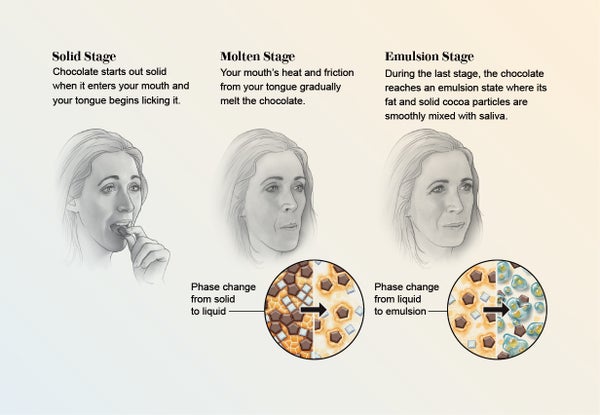
Illustration shows the face of a woman eating a piece of chocolate, and inset illustrations show the components of chocolate during solid, molten and emulsion stages.

David Cheney (illustration) and Jen Christiansen (charts)

Join Our Community of Science Lovers!


On supporting science journalism

If you're enjoying this article, consider supporting our award-winning journalism by subscribing. By purchasing a subscription you are helping to ensure the future of impactful stories about the discoveries and ideas shaping our world today.


The sensation of rich chocolate going gooey on your tongue is unlike any other. To understand how the process plays out on a molecular level, scientists created a biomimetic tongue that replicates the texture, surface distribution and mechanical properties of a human tongue. “We wanted to understand the main contributor to that smooth feeling of the chocolate as it melts,” says Siavash Soltanahmadi, a researcher at the University of Leeds in England. He and his collaborators, Anwesha Sarkar and Michael Bryant, placed chocolate on their ersatz tongue, then observed as the surfaces interacted. Their measurements allowed them to break down the chocolate-eating process into three stages: solid, molten and emulsion. The scientists discovered that the delectable feeling of chocolate depends on the snack releasing a fatty film that coats the tongue. “Where the fat is located in the chocolate is more important than how much of the fat we have,” Soltanahmadi says. This discovery suggests that by putting fat in the top layers of chocolate's surface and reducing fat in its interior, chefs could make a healthier treat that feels just as good in the mouth.
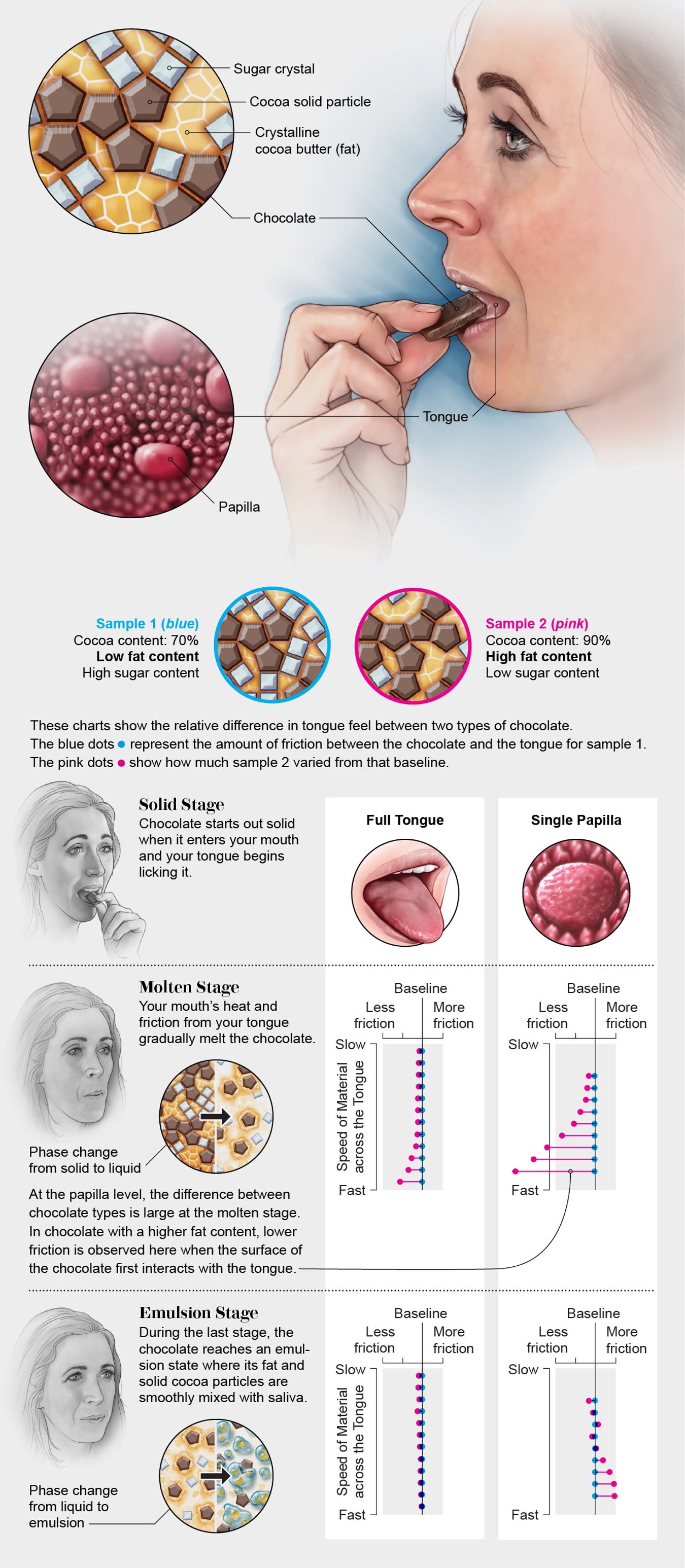
Credit: David Cheney (illustration) and Jen Christiansen (charts); Source: “Insights into the Multiscale Lubrication Mechanism of Edible Phase Change Materials,” by Siavash Soltanahmadi, Michael Bryant and Anwesha Sarkar, in ACS Applied Materials & Interfaces, Vol. 15; January 12, 2023 (data)

Clara Moskowitz is chief of reporters at Scientific American, where she covers astronomy, space, physics and mathematics. She has been at Scientific American for more than a decade; previously she worked at Space.com. Moskowitz has reported live from rocket launches, space shuttle liftoffs and landings, suborbital spaceflight training, mountaintop observatories, and more. She has a bachelor’s degree in astronomy and physics from Wesleyan University and a graduate degree in science communication from the University of California, Santa Cruz.

More by Clara Moskowitz

David Cheney is a Medical Illustrator and Creative Director based in the Midwest.

More by David Cheney
Scientific American Magazine Vol 328 Issue 4This article was published with the title “The Science of Melting Chocolate” in Scientific American Magazine Vol. 328 No. 4 (), p. 80
doi:10.1038/scientificamerican0423-80

It’s Time to Stand Up for Science

If you enjoyed this article, I’d like to ask for your support. Scientific American has served as an advocate for science and industry for 180 years, and right now may be the most critical moment in that two-century history.

I’ve been a Scientific American subscriber since I was 12 years old, and it helped shape the way I look at the world. SciAm always educates and delights me, and inspires a sense of awe for our vast, beautiful universe. I hope it does that for you, too.

If you subscribe to Scientific American, you help ensure that our coverage is centered on meaningful research and discovery; that we have the resources to report on the decisions that threaten labs across the U.S.; and that we support both budding and working scientists at a time when the value of science itself too often goes unrecognized.

In return, you get essential news, captivating podcasts, brilliant infographics, can't-miss newsletters, must-watch videos, challenging games, and the science world's best writing and reporting. You can even gift someone a subscription.

There has never been a more important time for us to stand up and show why science matters. I hope you’ll support us in that mission.

Thank you,

David M. Ewalt, Editor in Chief, Scientific American

Subscribe