The Scientific Question Machine

Scientific American Space & Physics August September 2020

Join Our Community of Science Lovers!

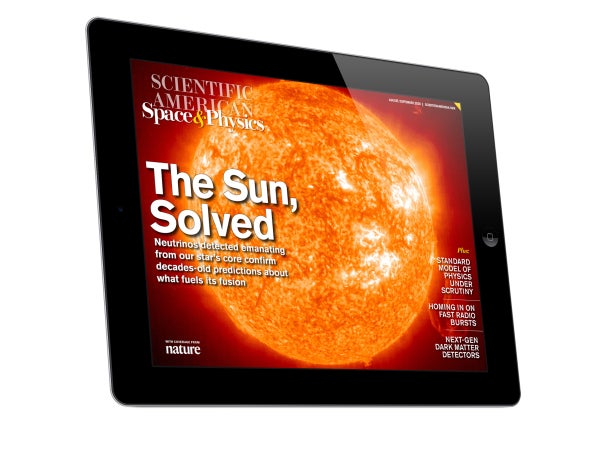
The title of this issue is a bit misleading. A fully explanatory and complete title would have gone something like: “Scientists Confirm Long-Standing Theory of Sun’s Power, but As with All Science, Many Questions Remain and New Ones Are Revealed.” Exhaustive, yes. Catchy? No. Though when it comes to attention-grabbing-if-slightly-truncated headlines, this one still holds water. As reporter Davide Castelvecchi reports, astrophysicists have long hypothesized that a small amount of the sun’s energy is generated by a particular reaction involving carbon and nitrogen in the star’s core, and can be detected by neutrino emissions (see “Neutrinos Reveal Final Secret of Sun’s Nuclear Fusion”). It’s always extremely satisfying when a scientific explanation is finally confirmed by direct evidence. In this case, the way that evidence was collected is fascinating, as are some of the further questions relevant to this research: What are the precise composition and temperature of the sun? What was our star like before the rest of the solar system formed? In science, it often goes that as soon as you’ve answered one question, you inadvertently have asked a dozen more. Call that frustrating or intriguing as you will.

Conflicting evidence about the weight of the cosmos is fueling a growing debate among physicists over the formation of the universe (see “How Heavy Is the Universe? Conflicting Answers Hint at New Physics”). And the surprise detection of radio bursts from within our own galaxy may help us resolve a larger cosmological phenomenon (see “‘Magnetic Star’ Radio Waves Could Solve the Mystery of Fast Radio Bursts”). But, you guessed it, this discovery is inciting a host of new questions waiting to be answered. I, for one, am intrigued.

Andrea Gawrylewski is chief newsletter editor at Scientific American. She writes the daily Today in Science newsletter and oversees all other newsletters at the magazine. In addition, she manages all special editions and in the past was the editor for Scientific American Mind, Scientific American Space & Physics and Scientific American Health & Medicine. Gawrylewski got her start in journalism at the Scientist magazine, where she was a features writer and editor for "hot" research papers in the life sciences. She spent more than six years in educational publishing, editing books for higher education in biology, environmental science and nutrition. She holds a master's degree in earth science and a master's degree in journalism, both from Columbia University, home of the Pulitzer Prize.

More by Andrea Gawrylewski
SA Space & Physics Vol 3 Issue 4This article was published with the title “The Scientific Question Machine” in SA Space & Physics Vol. 3 No. 4 ()
doi:10.1038/scientificamerican082020-68cIe2NAYVaIFwmuT9keyh

It’s Time to Stand Up for Science

If you enjoyed this article, I’d like to ask for your support. Scientific American has served as an advocate for science and industry for 180 years, and right now may be the most critical moment in that two-century history.

I’ve been a Scientific American subscriber since I was 12 years old, and it helped shape the way I look at the world. SciAm always educates and delights me, and inspires a sense of awe for our vast, beautiful universe. I hope it does that for you, too.

If you subscribe to Scientific American, you help ensure that our coverage is centered on meaningful research and discovery; that we have the resources to report on the decisions that threaten labs across the U.S.; and that we support both budding and working scientists at a time when the value of science itself too often goes unrecognized.

In return, you get essential news, captivating podcasts, brilliant infographics, can't-miss newsletters, must-watch videos, challenging games, and the science world's best writing and reporting. You can even gift someone a subscription.

There has never been a more important time for us to stand up and show why science matters. I hope you’ll support us in that mission.

Thank you,

David M. Ewalt, Editor in Chief, Scientific American

Subscribe