
It’s happening! Spring migration is peaking as birds race from their southern wintering grounds to their breeding grounds in the north. And although it’s always a good time to watch birds, now is the very best time for those of us in the Northern Hemisphere. We’re welcoming back the birds that nest where we live and hoping to catch sight of the ones that are touching down only briefly to rest and refuel before they head to points farther north. This is the moment bird-watchers have been waiting for—the wondrous window when hundreds of millions of birds may stream across the sky in a single night en route to claim a territory, find a mate, build a nest and reproduce.
In the northeastern U.S., where I roost, the migrants have been trickling in for a couple of months. The Tree Swallows arrived in March and are now building their nests with grasses and pine needles from the surrounding fields. The Blue-gray Gnatcatchers followed in April. They’ve been flitting among the treetops and are so tiny and fast that often I identify them not by their physical traits but by their distinctive call, a wheezy utterance from the world’s smallest kazoo. If I hear a call or song I don’t recognize, I may consult the Merlin bird app, which has a sound identification feature that’s like Shazam for bird vocalizations, and see if it can match the sound to one in its database. Merlin isn’t perfect, though—it’s best to confirm the app’s suggestions with your own eyes and ears if you can.
Recently at a local beach, I watched two American Oystercatchers pick their way along the pebbled shore to nab tiny limpets with their long orange bills. One of the birds had bands on its legs, indicating that it had been captured and assigned an identification number for the North American Bird Banding Program. Data on sightings of banded birds allow scientists to track changes in bird populations, behaviors and environments. I reported the oystercatcher on the program’s website when I got home from my walk, and two days later I received a certificate of appreciation noting that my bird was banded in a neighboring town in the spring of 2025 and had hatched in 2024 or earlier. I wonder where it will turn up next.
On supporting science journalism
If you're enjoying this article, consider supporting our award-winning journalism by subscribing. By purchasing a subscription you are helping to ensure the future of impactful stories about the discoveries and ideas shaping our world today.
I’m a night owl at heart. But now that migration is ramping up, I’m turning in early—right after I check the bird migration forecast to see what tomorrow might bring—and rising with the sun to make the most of the early mornings, when birds are busiest. My alarm clock is nature’s own: the American Robin singing outside my bedroom window at daybreak.
My species checklists, which I record in the online database eBird, are growing longer each day. Earlier this week, I encountered my first Rose-breasted Grosbeaks and Orchard Orioles of the season—newly arrived from Central America and northern South America—singing as they foraged for buds and caterpillars in the blossoming apple trees. And just yesterday, while commuting to work through the Battery, a park at the southern tip of Manhattan, I spied my first Worm-eating Warbler of the year way up in an oak tree, where it was hunting for insects among the pale new leaves. The sight took me by surprise because this species tends to hang out in the understory of dense forests, often on steep slopes. But it was a reminder of a cardinal rule of birding: anything can happen during migration. (To the cyclist I accidentally backed into while intently observing an Ovenbird at the edge of the bike path: I’m sorry. Thank you for being kind in the face of my birds-on-the-brain obliviousness.)
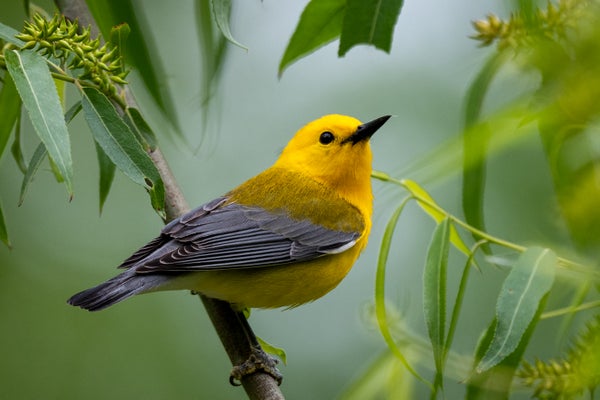
In addition to welcoming familiar faces as migration progresses, I’m hoping to add some new species to my life list. I’ve been searching the forested lakes and streams in my area for a Prothonotary Warbler, a splendid saffron-headed songbird with obsidian eyes and wings of smoke. We only get a handful each spring, mostly so-called overshoot migrants that end up farther north than their breeding grounds. This species has eluded me for the six years I’ve been bird-watching, so I suppose that makes it what bird nerds call a nemesis bird. But tonight 147 million birds are predicted to take wing over North America. Some of them will be Prothonotary Warblers. Maybe one will drop into the riverside willows at the cemetery I like to visit. Maybe I’ll find it tomorrow.
Here’s how to enjoy the spectacle of spring migration.
Birding Tools
Fundamentally, birding is about observing wild birds in all their glory. There is no single right way to do it. You do whatever works for you. That said, there are some excellent tools that can help people identify and report birds. In fact, one could argue that, with all the technology that’s now available—much of it on our phones—we’re living in the golden age of bird-watching.
The counterargument is that all these apps are diminishing our powers of observation and that bird-watching is better when you unplug. There’s something to be said for leaving the phone at home and fully immersing oneself in the birding moment.
At the very least, though, I recommend getting some binoculars. The good news is that you no longer have to shell out thousands of dollars to get a pair with many of the features that were once reserved for the very best bins. Here’s the science behind top-tier optics for nature observation.
Bird Biology
There is so much to appreciate about birds. Let’s start with their feathers. Not only are feathers beautiful to look at, but they also have special features that help the animals fly and keep warm and dry. In fact, feathers are one of evolution’s cleverest inventions.
Bird vocalizations are another source of fascination. We humans naturally zero in on the melodies in their songs, and we tend to think about the components of these melodies in the same way that we think about words in human language. But the catchy tunes are not what the birds themselves are paying attention to. Here’s what birds really listen for in birdsong.
As someone with an appallingly bad sense of direction, I’m floored by the fact that birds can travel tens of thousands of miles between their breeding grounds and wintering grounds and arrive at the right place most of the time. It turns out that they use quantum effects to navigate 🤯.
Bird Evolution
How did today’s birds get to be so amazing? First, their ancestors had to survive the dinosaurs’ doomsday, which was no small feat.
Then they evolved all manner of shapes, sizes and feeding specializations. More than 10,000 bird species exist today, which makes them the most diverse group of land vertebrates around. Scientists are continually learning more about how this incredible avian diversity evolved.
Somewhere along the line, some birds began migrating long distances to the Arctic to breed, which, on the face of things, seems like a pretty bonkers thing to do. Recent fossil discoveries hint at when and how birds started making this journey.
How to Help Birds
Bird populations are in decline. Anecdotally, my friends who have been birding for decades all seem to have stories about how many more birds they used to see. Scientific studies confirm this observation: North America has lost some three billion birds since 1970. Data from banded birds, such as my American Oystercatcher, help scientists track bird populations, so if you spot a banded bird, report it.
Migration is a dangerous event in a bird’s life. It might encounter a terrible storm or a hungry predator. It might lose its way. Worst of all, it might get thrown off by artificial light at night—or not see glass surfaces during the day—and collide with a window to its death. Turning off unneeded lights at night and putting bird-friendly stickers on windows can help birds navigate urban environments safely.
Just for Fun
There’s birding, and then there’s competitive birding. I wrote about a team of extreme birders and their race to find as many species as they could in 24 hours in hopes of setting a new “Big Day” record for New England. It was absolutely bananas.
A Big Day is so intense that I can’t imagine the 365-day version. But that’s exactly what brothers Owen and Quentin Reiser did, setting off in a minivan across the Lower 48 states in a bid to break the Big Year record as novice birders. They made a hilarious documentary, called Listers: A Glimpse into Extreme Birdwatching, about their adventure. I loved every madcap minute of it.