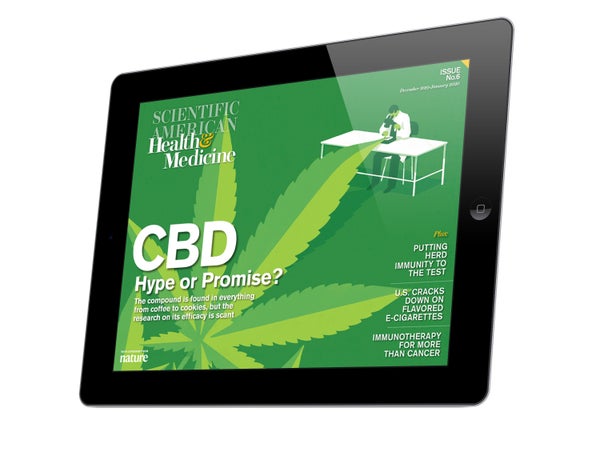
The Straight Dope on CBD

The compound is found in everything from coffee to cookies, but the research on its efficacy is scant

SA Health & Medicine Vol 1 Issue 6 Cover

Chris Gash

Join Our Community of Science Lovers!


On supporting science journalism

If you're enjoying this article, consider supporting our award-winning journalism by subscribing. By purchasing a subscription you are helping to ensure the future of impactful stories about the discoveries and ideas shaping our world today.


In June 2018 the FDA approved the drug Epidiolex, the first pharmaceutical drug made from cannabidiol (CBD) and intended to treat two very severe forms of epilepsy. The announcement seemed to add to the growing prominence of CBD—although it remains a Schedule I controlled substance in the U.S. In many health food stores and head shops, you can find CBD in everything from body lotion and bath bombs to chocolate and pet treats. A friend recently reported that she spotted CBD-infused condoms while traveling in Amsterdam. CBD is certainly having its moment. It is purported to calm inflammation, anxiety and pain. But the science on the efficacy of CBD is scant. As Amber Dance reports in “CBD: Hype or Promise?” the number of peer-reviewed studies on the compound barely numbers in the dozens. Which is sobering for an industry expected to grow to nearly $15 billion, by some estimates, in the next five years.

In Japan, deregulation of experimental stem cell treatments may prove harmful to many, as David Cyranoski writes in “Stem Cells 2 Go.” And so-called vaccine hesitancy—the resistance by small clusters of individuals to get their children vaccinated—is spurring new strategies to track and tackle the spread of deadly diseases, as Lynne Peeples describes in “Rethinking Herd Immunity.” As always, enjoy the issue!

Andrea Gawrylewski is chief newsletter editor at Scientific American. She writes the daily Today in Science newsletter and oversees all other newsletters at the magazine. In addition, she manages all special editions and in the past was the editor for Scientific American Mind, Scientific American Space & Physics and Scientific American Health & Medicine. Gawrylewski got her start in journalism at the Scientist magazine, where she was a features writer and editor for "hot" research papers in the life sciences. She spent more than six years in educational publishing, editing books for higher education in biology, environmental science and nutrition. She holds a master's degree in earth science and a master's degree in journalism, both from Columbia University, home of the Pulitzer Prize.

More by Andrea Gawrylewski
SA Health & Medicine Vol 1 Issue 6This article was published with the title “The Straight Dope on CBD” in SA Health & Medicine Vol. 1 No. 6 (), p. 2
doi:10.1038/scientificamerican122019-m8Hn6h80XjkTiHmTpTPo5

It’s Time to Stand Up for Science

If you enjoyed this article, I’d like to ask for your support. Scientific American has served as an advocate for science and industry for 180 years, and right now may be the most critical moment in that two-century history.

I’ve been a Scientific American subscriber since I was 12 years old, and it helped shape the way I look at the world. SciAm always educates and delights me, and inspires a sense of awe for our vast, beautiful universe. I hope it does that for you, too.

If you subscribe to Scientific American, you help ensure that our coverage is centered on meaningful research and discovery; that we have the resources to report on the decisions that threaten labs across the U.S.; and that we support both budding and working scientists at a time when the value of science itself too often goes unrecognized.

In return, you get essential news, captivating podcasts, brilliant infographics, can't-miss newsletters, must-watch videos, challenging games, and the science world's best writing and reporting. You can even gift someone a subscription.

There has never been a more important time for us to stand up and show why science matters. I hope you’ll support us in that mission.

Thank you,

David M. Ewalt, Editor in Chief, Scientific American

Subscribe