
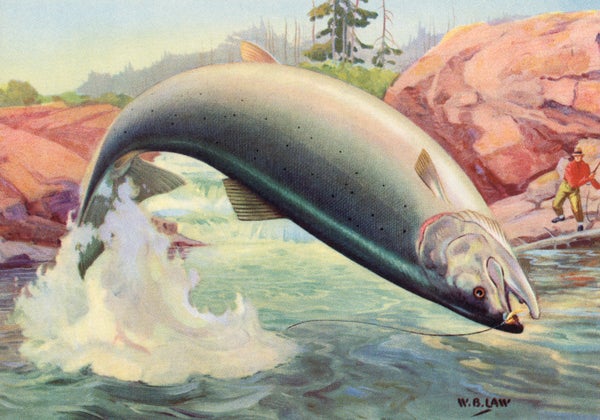
Strange but true: salmon on cocaine swim a lot more.
But they’re not doing lines in the bathroom—they’re part of a new study. This sounds like an odd thing to research, but cocaine and its metabolites—along with other drugs and pharmaceuticals—are widespread in the environment, mainly from human wastewater. And scientists are working to understand how such substances might affect wildlife.
“Many aquatic organisms in human-impacted environments are living in a dilute cocktail of biologically active chemicals,” says Jack Brand, a researcher in aquatic ecology at the Swedish University of Agricultural Sciences. “We’re only really scratching the surface.”
On supporting science journalism
If you're enjoying this article, consider supporting our award-winning journalism by subscribing. By purchasing a subscription you are helping to ensure the future of impactful stories about the discoveries and ideas shaping our world today.
In the new study, Brand and his colleagues focused on wild Atlantic salmon (Salmo salar). The team fitted 105 juvenile salmon reared in captivity with an acoustic tracking tag and an implant. In one group of 35, the implant slowly released cocaine, in another it released benzoylecgonine (cocaine’s main metabolite), and in a control group it released nothing. They then released the salmon into Lake Vättern in Sweden to see what happened.
The results, published on Monday in Current Biology, show that coked-up salmon were really craving swimming.
Fish under the influence of benzoylecgonine swam up to 1.9 times (nearly 14 kilometers) farther on average each week compared with salmon that weren’t exposed. They also dispersed more, reaching up to about 12 kilometers farther from the release site than nonexposed fish did—a 60 percent increase.
Benzoylecgonine had a stronger effect than cocaine itself, but the researchers aren’t completely sure why yet. “That was somewhat unexpected and has important implications because environmental risk assessments typically focus on the parent compound rather than its metabolites,” Brand says, adding that “benzoylecgonine is routinely found at higher concentrations than cocaine in aquatic environments.”
Rachel Ann Hauser-Davis, a biologist at the Oswaldo Cruz Foundation in Brazil, who wasn’t involved in the research, says that the study was an important step forward because previous research had only been conducted in laboratory settings. But she notes that slow-release implants don’t perfectly mimic how a fish might encounter contamination in the water naturally.
The effects from cocaine exposure might have important implications for the salmon: Fish that travel longer distances might enter unsuitable habitats or spend valuable energy on swimming rather than using it to forage and grow. And they might change what types of predators and food they encounter. Atlantic salmon are already affected by climate change, habitat loss, and more, Brand says, so additional pressure like this one “could have cascading consequences.”
Because benzoylecgonine and cocaine are widespread in the environment, this might represent a problem for many other species as well. Previous studies showed effects on the behavior and physiology of other aquatic animals such as European eels and crayfish. And recent research demonstrated how cocaine and its metabolites can accumulate in wild fish such as sharks.
But concentrations in salmon should be much lower than what would affect humans, Brand says, so you can still have a roasted fillet or a bagel with lox.