The Sunspot Cycle Is More Intricate Than Previously Thought

The sun's dark spots cycle every 11 years—as well as every 88, 200, and 2,400 years

Join Our Community of Science Lovers!


On supporting science journalism

If you're enjoying this article, consider supporting our award-winning journalism by subscribing. By purchasing a subscription you are helping to ensure the future of impactful stories about the discoveries and ideas shaping our world today.


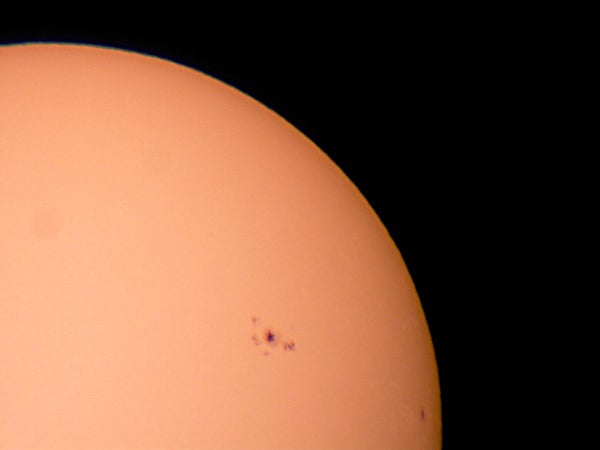
The sun's pockmarked surface is always shifting. Sunspots and solar flares rise and fall every 11 years, a cycle associated with regular reversal of the star's magnetic field. Huge quantities of plasma—known as coronal mass ejections—fly into space, which can disrupt satellites and other electronic signals if they reach Earth. More solar activity during the cycle also amplifies auroras and warms Earth's temperatures slightly. Yet careful study has shown that longer periodicities exist, too. The Gleissberg cycle, first identified in 1862, strengthens and weakens the 11-year cycle over the course of a century (shown in yellow). One paper posits that the Gleissberg pattern is caused by a slow swaying of the sun's magnetic pole. The Suess-DeVries cycle (green) lasts about 200 years, whereas the Hallstatt cycle (blue) runs on the order of 2,400 years. Still, the sun can also be erratic, making it tricky for physicists to predict future sunspots, says Alexei Pevtsov, an astronomer at the National Solar Observatory in Boulder, Colo.: “There's an element of randomness.”

Credit: Katie Peek; Sources: SILSO data, Royal Observatory of Belgium, Brussels; “Solar Activity Nine Millennia: A Consistent Multi-Proxy Reconstruction,” by Chi Ju Wu et al., in Astronomy & Astrophysics; April 4, 2018; Daguerreotype image of sun by Louis Fizeau (1845 image); Carnegie Institution of Washington (1947 image); Sunspot drawing from John of Worcester's chronicle of England (1128 image)

Katie Peek is a science journalist and data-visualization designer with degrees in astrophysics and journalism. She is a contributing artist for Scientific American.

More by Katie Peek
Scientific American Magazine Vol 319 Issue 2This article was published with the title “Sunspot Surprise” in Scientific American Magazine Vol. 319 No. 2 (), p. 84
doi:10.1038/scientificamerican0818-84

It’s Time to Stand Up for Science

If you enjoyed this article, I’d like to ask for your support. Scientific American has served as an advocate for science and industry for 180 years, and right now may be the most critical moment in that two-century history.

I’ve been a Scientific American subscriber since I was 12 years old, and it helped shape the way I look at the world. SciAm always educates and delights me, and inspires a sense of awe for our vast, beautiful universe. I hope it does that for you, too.

If you subscribe to Scientific American, you help ensure that our coverage is centered on meaningful research and discovery; that we have the resources to report on the decisions that threaten labs across the U.S.; and that we support both budding and working scientists at a time when the value of science itself too often goes unrecognized.

In return, you get essential news, captivating podcasts, brilliant infographics, can't-miss newsletters, must-watch videos, challenging games, and the science world's best writing and reporting. You can even gift someone a subscription.

There has never been a more important time for us to stand up and show why science matters. I hope you’ll support us in that mission.

Thank you,

David M. Ewalt, Editor in Chief, Scientific American

Subscribe