
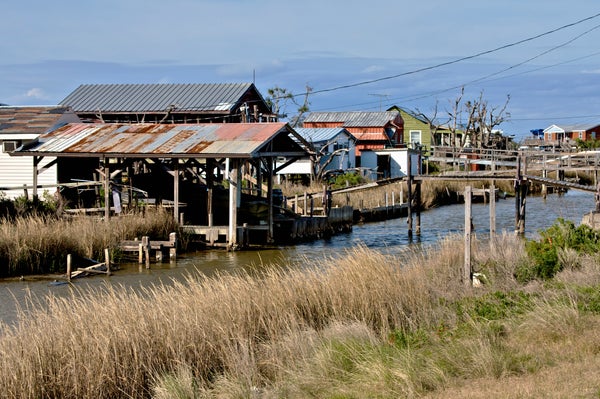
Rising seas, storm surges and coastal flooding are displacing communities from Alaska to Louisiana to Maryland.
It's time for Congress to get serious about helping them find higher ground, federal auditors say in a blunt assessment of the government's scattershot approach to what could become the largest U.S. migration since the Dust Bowl of the 1930s.
In a 61-page report issued yesterday, the Government Accountability Office said Congress should consider a pilot program "to identify and provide assistance to climate migration projects for communities that express affirmative interest in relocation as a resilience strategy."
On supporting science journalism
If you're enjoying this article, consider supporting our award-winning journalism by subscribing. By purchasing a subscription you are helping to ensure the future of impactful stories about the discoveries and ideas shaping our world today.
"Unclear federal leadership is the key challenge to climate migration as a resilience strategy," GAO added, noting that previous support for communities seeking to relocate has been provided in an ad hoc manner with no overarching strategy.
GAO's findings are based on expert interviews and a review of 52 studies and other documents about climate adaptation, including the Fourth National Climate Assessment released in 2018. The assessment said relocation of people and infrastructure due to climate change "will become an unavoidable option in some areas along the U.S. coastline."
Anna Weber, a policy analyst and expert on climate change adaptation and resilience with the Natural Resources Defense Council, said the report offers an opportunity to rethink the government's role in climate adaptation. But, she added, "The federal government has a really horrific history of trying to move people from place to place. This may be one of the first times a federal report has come saying let's try to do it right."
In absence of a cohesive federal policy, communities often seek solutions without adequate resources or knowledge. In a few places — like Isle de Jean Charles, La., and Newtok, Alaska — federal agencies have provided block grants and coordinated with state, local and tribal entities to push relocation efforts forward with varying degrees of success.
Both communities have faced delays and other bureaucratic obstacles in moving to higher ground.
In other locations, like Smith Island, Md., a fishing hamlet in the middle of the Chesapeake Bay, officials have opted to adapt in place, using Superstorm Sandy recovery dollars and other government assistance to develop a shoreline protection plan.
A 2013 proposal to use federal block grants for home buyouts on the island met strong resistance from residents. It strained working relationships between local, state and federal entities, according to GAO.
It's not just ocean communities weighing relocation options. Santa Rosa, Calif., considered retreating from parts of the wildland-urban interface after the Tubbs Fire burned much of the city in 2017. The idea lacked sufficient funding and public support, leading to other adaptation approaches, GAO said.
While retreat and relocation strategies have foundered at the federal level, Congress has continued to spend hundreds of billions of dollars in disaster assistance to rebuild communities where they are, even as they face growing climate risk.
Since 2005, Congress has allocated nearly a half-trillion dollars in disaster relief to communities struck by hurricanes, fires, floods and droughts, according to GAO. And the pace of spending has quickened, with nearly $200 billion in taxpayer money spent since 2015. It has not been a good investment, according to GAO and other disaster experts.
To break the budget-busting cycle of climate disaster and reconstruction, GAO said the government should assist communities in identifying options for retreat. Such work should be coordinated through a single agency or program where communities can glean sound information and advice about their options.
The federal government also needs to account for the disproportionate effect of climate disasters on poor and disadvantaged communities that have fewer resources.
Auditors said "institutional barriers, such as federal programs that do not account for the unique context of tribal communities and tribal sovereignty may constrain tribal communities' ability to pursue self-determined management of their resources and built environment."
Weber of NRDC agreed but also cautioned that the government needs to support a variety of risk mitigation strategies, including home buyouts and restoration of natural floodplains. That's especially true for communities that are tightly bound to their locations for economic, cultural or religious reasons.
"Adapting to climate change has to be about self-determination by communities. Otherwise we're going to be perpetuating the problems that got us here in the first place," she said.
Reprinted from Climatewire with permission from E&E News. E&E provides daily coverage of essential energy and environmental news at www.eenews.net.
