
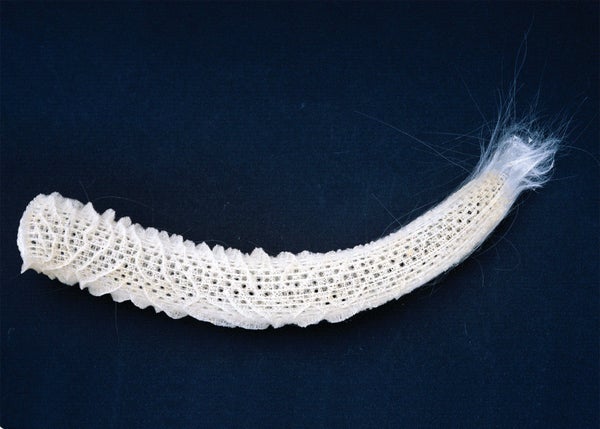
Although their exteriors are made from intricately woven glass fibers, Venus's flower basket sponges are better known for something often found inside them: a breeding pair of shrimp that becomes trapped within the sponge's lava-lamp-shaped body and goes on to live there symbiotically. This romantic biology is the reason the deep-sea sponges are presented as wedding gifts in Japan—and it is also why a team of engineers became curious about how water passes through the sponges, helping their captives thrive.
The team theorized that the sponges' eye-catching patterns of ridges and holes altered the flow of water in and around the organisms. But an underwater experiment to pinpoint the effect of each structural attribute would have been logistically impossible. Instead the team ran a series of simulations, developed over the course of a decade, on one of Italy's highest-powered supercomputers. “I think this represents simulation at its best—something that you cannot do by experiment,” says Sauro Succi, a senior research executive at the Italian Institute of Technology in Rome and co-author of the new study, published in Nature.
The researchers built a virtual three-dimensional model based on measurements of real sponges. Next they simulated billions of individual particles passing through it, with and without the ridges and holes. They discovered that the organism's porous lattice structure reduces drag from the flow of the water, and the ridges temper the water's force and create tiny vortices inside the sponge. These swirls make it easier for the sponge's eggs and sperm to mix while allowing the sponge—and the shrimp within—to feed more efficiently.
On supporting science journalism
If you're enjoying this article, consider supporting our award-winning journalism by subscribing. By purchasing a subscription you are helping to ensure the future of impactful stories about the discoveries and ideas shaping our world today.
According to study lead author Giacomo Falcucci of the University of Rome Tor Vergata, this “twofold benefit” of durability and fertility surprised the team because evolutionary adaptations to boost breeding success often harm an organism in other departments. A peacock's attractive but heavy tail is one example of such a trade-off.
“It is really cool to see a study like this show that this complex morphology does really have [intriguing] implications for fluid dynamics,” says Laura Miller, a mathematician and biomedical engineer at Arizona State University who was not involved with the research but authored an accompanying commentary in Nature.
In future research, this simulation method can be applied to other organisms whose fluid dynamics have never been minutely studied—Miller suggests a coral reef's intricate architecture could be one target. Plus, Venus's flower baskets have already inspired biomaterials, including a 3-D-printed grid that sustained more load without buckling than current bridges' lattice structures. By understanding the sponge's flow properties as well, the co-authors say they hope drag-reducing design principles could enhance tomorrow's skyscrapers, submarines and spaceships.