
The world is doing far too little to prepare for the impacts of a warming planet, even as climate-fueled storms, floods, heat waves and drought become more extreme.
That’s the conclusion of the latest report from the U.N. Environment Programme, which finds that efforts to build defenses against climate change impacts—what’s known as adaptation—are not keeping up with the growing risks they pose to humanity.
“The world must urgently reduce greenhouse gas emissions to limit the impacts of climate change. But we must also urgently increase efforts to adapt to the impacts that are already here and those to come,” Inger Andersen, executive director of the U.N. Environment Programme, said in a statement.
On supporting science journalism
If you're enjoying this article, consider supporting our award-winning journalism by subscribing. By purchasing a subscription you are helping to ensure the future of impactful stories about the discoveries and ideas shaping our world today.
Adaptation—and funding to support it—will be a major focus of international climate talks set to start Sunday in Sharm el-Sheikh, Egypt. At last year’s summit, developed countries agreed to double the amount of money they were committing to help countries invest in efforts such as drought-tolerant crops, coastal defenses and other disaster-resilient infrastructure.
That would boost finance from $20 billion in 2019 to $40 billion by 2025. But the U.N. report finds that between $160 billion and $340 billion will be needed by 2030 to respond to growing adaptation needs. Without more support, climate risks could overtake countries’ efforts to respond—putting them further under treat, the report states.
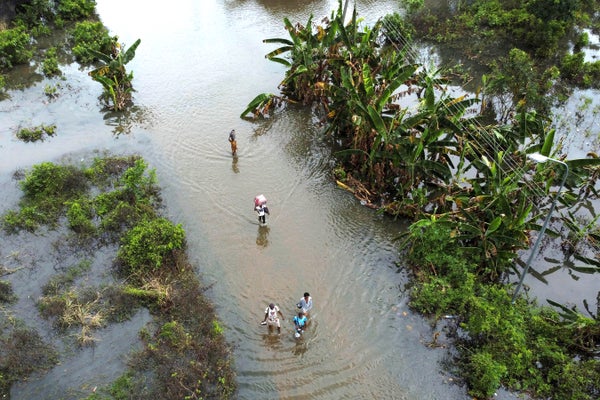
A series of catastrophic climate events this year, punctuated by historic flooding in Pakistan that killed around 1,700 people and left up to $40 billion in damage, has cast a spotlight on the need to harden countries’ resources before disasters occur and find ways to make them whole again once harms have been inflicted.
Climate impacts will only get worse if the world continues on its current trajectory. A sister report from the U.N. Environment Programme released last week showed that under countries’ current policies, temperatures are set rise 2.8 degrees Celsius by the end of the century, well above the 1.5 C goal laid out in the Paris Agreement.
The lack of action has put a spotlight on the need for adaptation. It also has highlighted a new and rising threat: losses and damages that occur when climate impacts cannot be adapted to.
And the countries that have done the least to cause the problem—and have fewer resources to deal with them—are forced to bear the consequences.
“Those on the front lines of the climate crisis are at the back of the line for support,” U.N. Secretary-General António Guterres said at the launch of the UNEP report. “This is unacceptable.”
He’s pushing an initiative aimed at accelerating finance for adaptation projects that will be launched in Egypt. It will hinge on helping countries’ turn their adaptation needs into bankable projects and then match them with lenders who can work together to deliver large-scale investments rather than small, scattered ones.
“Quite frankly, that is one of the challenges that we've had over the course of the last 30 years on the adaptation front, right, translating what we know and what we see as priorities in countries into something tangible that can be invested in to help a country to boost its resilience to the climate crisis,” said a senior U.N. official speaking to reporters on background about the U.N.-led initiative.
A large majority of countries have adaptation plans or strategies, but many lack detail or timelines and they have struggled to attract investment. While money for adaptation has grown slightly in recent years, it still represents only around a third of total climate finance, with the bulk going toward clean energy deployment and other emissions-reduction efforts that provide a clearer return on investment.
At a time when the world is facing major global challenges, the report calls for “unprecedented political will” and greatly scaled-up investments in adaptation to prevent the gap from widening.
Guterres and a host of other leaders also have called for a major overhaul to the way that development banks—the World Bank in particular—extend finance to help developing countries tackle climate change (Climatewire, Oct. 7).
“The investment pipeline is blocked; we must unblock it now,” Guterres said.
He also called on rich nations that have failed to meet a pledge to provide poorer ones with much-needed climate finance to present a plan with clear timelines for how they will deliver on their commitments.
“If we don’t want to spend the coming decades in emergency response mode, dealing with disaster after disaster, we need to get ahead of the game,” Andersen, the UNEP head, wrote in a forward to the report.
Reprinted from E&E News with permission from POLITICO, LLC. Copyright 2022. E&E News provides essential news for energy and environment professionals.