Theories Realized

A 10-year effort pays off and finally reveals the shadowy face of a supermassive black hole

Event Horizon Telescope collaboration et al.

Join Our Community of Science Lovers!


On supporting science journalism

If you're enjoying this article, consider supporting our award-winning journalism by subscribing. By purchasing a subscription you are helping to ensure the future of impactful stories about the discoveries and ideas shaping our world today.


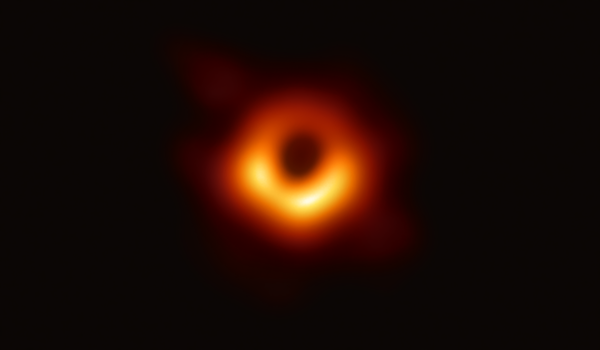
About 1.3 billion years ago two black holes collided and sent undulating waves outward through spacetime like ripples on a pond. Here on Earth in the fall of 2015, a sensitive laser-based instrument recorded the waves and offered the first tangible evidence of black holes since Albert Einstein theorized their existence more than 100 years ago. And now, for the first time, scientists have taken a photograph of a black hole. As Lee Billings reports in “At Last,” at least nine radio telescopes across the globe linked together and snapped the image of the black hole at the center of the Messier 87 galaxy. Aligning with Einstein’s predictions, the center of the black hole is a dark shadow, surrounded by a vividly glowing ring of gas. As Carl Sagan once said, extraordinary claims require extraordinary evidence. And we can now say—more than ever—that we have the extraordinary evidence to conclude that black holes exist. Einstein, I surmise, would be pleased.

Elsewhere in the world of abstract theoretical physics, Anil Ananthaswamy reports that a group of mathematicians working on the “F-theory” branch of string theory has stumbled on a quadrillion—yes, three more zeros than a trillion—new potential solutions to string theory (see “Found: A Quadrillion Ways for String Theory to Make Our Universe”). And nearly 10 years on Christine-Maria Horejs and Giulia Pacchioni cover the many upgrades and future projects in the works at CERN (see “CERN’s Next Big Thing”). The quarry of physics research is vast, and we are now netting some admirable catch.

Andrea Gawrylewski is chief newsletter editor at Scientific American. She writes the daily Today in Science newsletter and oversees all other newsletters at the magazine. In addition, she manages all special editions and in the past was the editor for Scientific American Mind, Scientific American Space & Physics and Scientific American Health & Medicine. Gawrylewski got her start in journalism at the Scientist magazine, where she was a features writer and editor for "hot" research papers in the life sciences. She spent more than six years in educational publishing, editing books for higher education in biology, environmental science and nutrition. She holds a master's degree in earth science and a master's degree in journalism, both from Columbia University, home of the Pulitzer Prize.

More by Andrea Gawrylewski
SA Space & Physics Vol 2 Issue 3This article was published with the title “Theories Realized” in SA Space & Physics Vol. 2 No. 3 (), p. 2
doi:10.1038/scientificamericanspace0619-02

It’s Time to Stand Up for Science

If you enjoyed this article, I’d like to ask for your support. Scientific American has served as an advocate for science and industry for 180 years, and right now may be the most critical moment in that two-century history.

I’ve been a Scientific American subscriber since I was 12 years old, and it helped shape the way I look at the world. SciAm always educates and delights me, and inspires a sense of awe for our vast, beautiful universe. I hope it does that for you, too.

If you subscribe to Scientific American, you help ensure that our coverage is centered on meaningful research and discovery; that we have the resources to report on the decisions that threaten labs across the U.S.; and that we support both budding and working scientists at a time when the value of science itself too often goes unrecognized.

In return, you get essential news, captivating podcasts, brilliant infographics, can't-miss newsletters, must-watch videos, challenging games, and the science world's best writing and reporting. You can even gift someone a subscription.

There has never been a more important time for us to stand up and show why science matters. I hope you’ll support us in that mission.

Thank you,

David M. Ewalt, Editor in Chief, Scientific American

Subscribe