
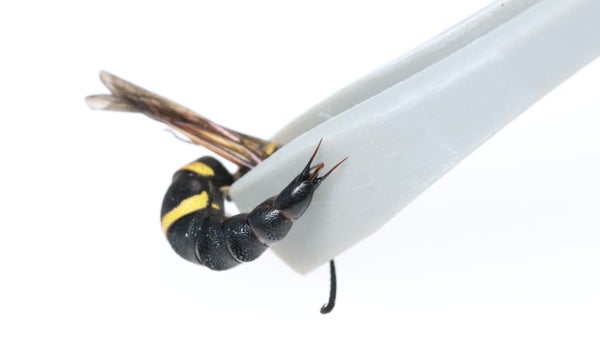
Males of one wasp species use their genitals as an antipredator defense, mimicking females and jabbing potential attackers with spines mounted on their reproductive organs, a new study has found.
One day while studying the life cycle of mason wasps (Anterhynchium gibbifrons), researcher Misaki Tsujii of Kobe University in Japan felt a “pricking pain” as she handled one of the male insects. At first she thought she'd been stung—a surprise because most males of the insect order Hymenoptera, to which wasps belong, do not have stingers. But further examination showed that the jab likely came from two sharp protrusions, one on each side of the male wasp's genitalia. Rather than aiding in mating, these spines seem to serve the purpose of poking predators—and a new study by Tsujii and Kobe University insect ecologist Shinji Sugiura explores how.
“This study highlights the significance of male genitalia as an antipredator defense and opens a new perspective for understanding the ecological role of male genitalia in animals,” says Sugiura, lead author of the paper published in Current Biology.
On supporting science journalism
If you're enjoying this article, consider supporting our award-winning journalism by subscribing. By purchasing a subscription you are helping to ensure the future of impactful stories about the discoveries and ideas shaping our world today.
To confirm that pseudo stinging is used as a defense, the researchers placed wasp females, intact wasp males and wasp males whose genitalia had been removed in tanks with species of known wasp-eating tree frogs and pond frogs. The frogs devoured all 17 male wasps without genitalia. Pond frogs ate every wasp they encountered, but 35 percent of the intact male wasps were able to fight off tree frog predation with pseudo stings, causing the frogs to spit them out. Eighty-seven percent of the female wasps escaped the tree frogs as well.
Justin Schmidt, a stinging insect expert at University of Arizona and author of the book The Sting of the Wild, says that the males' pseudo stinging probably contributed to the experimental results. The frogs' somewhat small size, relative to the wasps, and the size difference between male wasps and naturally larger females were also likely factors. Schmidt, who was not involved in the new study, adds that it's not surprising that wasps with their whole genitals removed were less effective at fighting the frogs—and that he'd like to see the experiment replicated with wasps that had only the spines removed. Removing the entire apparatus, he notes, might be “awfully traumatic” for the wasps.
The male wasps may gain an evolutionary advantage by acting like females, whose stings inject venom and cause serious harm. To scare a predator into spitting it out, a male wasp “doesn't actually have to do the damage,” Schmidt says. “It has to trick us into thinking that it's doing the damage.”
Few other animal species have been shown to use their genitals as a defense mechanism, the authors write in their study—although hawk moths occasionally use special scales on their genitals to produce ultrasonic noises that are hypothesized to confuse predatory bats.
