
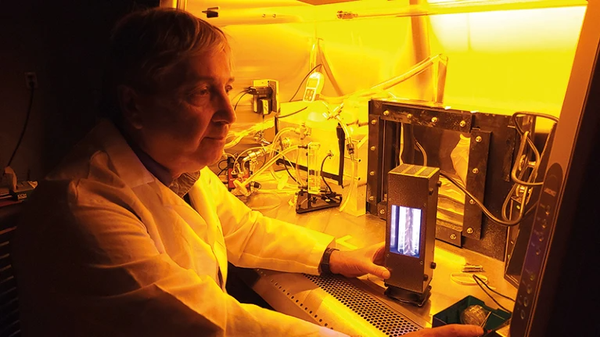
The Boston piano bar where Edward Nardell was singing cabaret songs in 2022 would typically be an ideal setting for airborne diseases to spread. But Nardell and his audience were protected during the COVID-19 pandemic by the far-ultraviolet (UV) lights he had installed to shine down from the ceiling.
Far UV is an emerging form of germicidal UV (GUV) irradiation, a well-established disinfection technology and a growing resource in the battle against pathogens that can spread easily through the air in enclosed spaces.
Indoor air safety begins with ventilation, but it usually can’t end there, says Nardell, a physician and researcher in airborne infection at the Harvard T. H. Chan School of Public Health. Ventilation systems that replace air in a room are rarely powerful enough to fully protect against coronaviruses and other easily caught diseases, he explains.
On supporting science journalism
If you're enjoying this article, consider supporting our award-winning journalism by subscribing. By purchasing a subscription you are helping to ensure the future of impactful stories about the discoveries and ideas shaping our world today.
Systems that actively try to clean the air in rooms, such as those using high-efficiency particulate air (HEPA) filters, remove harmful particles more effectively. But they are expensive to install and operate, often noisy, and limited in reach—multiple devices might be needed to cover a room. “That’s where the air sanitation with UV comes in,” says Donald Milton, an environmental health researcher at the University of Maryland School of Public Health in College Park.
With GUV light, “you can get very high rates of air disinfection with relatively little air movement,” Milton says. “And with the newest technology, maybe you don’t even have to worry about air movement, because now there are wavelengths that are safer to use, and you can use GUV in the whole room.” In crowded spaces such as schools, hospitals and restaurants where diseases can easily spread, GUV can operate unnoticed “even before you know that you’ve got a problem,” Milton says. “That’s really critical in keeping these things under control.”
Gunning for germs
Conventional GUV systems use mercury vapor lamps, which produce light by passing an electric current through vaporized mercury and are similar to conventional fluorescent bulbs. The lamps emit radiation in the UVC band, with a wavelength of around 254 nanometers. UVC radiation is filtered by the atmosphere, so life on Earth has not evolved to withstand it. The radiation inflicts photochemical damage that mangles nucleic acids—inactivating pathogenic viruses and bacteria, though not necessarily killing them.
The lamps are widely used to disinfect water, clean fruits and vegetables, and sanitize surfaces in spaces such as operating rooms. But because this wavelength can damage human eyes and skin, the light from these systems is kept away from people. That does not mean, however, that it can’t be deployed in public spaces. A clever approach developed decades ago, known as upper-room GUV, places the lamps high in a room and takes advantage of rising air currents to inactivate pathogens well away from people.
The technique works well, says William Bahnfleth, an architectural engineer at Pennsylvania State University who focuses on indoor air quality. In a room, air rises from people, equipment and existing ventilation, passes through the radiation zone of the lamps, and then circulates back down into the occupied space.
Although there are no universally accepted and enforced standards for indoor air quality, targets are typically expressed in terms of how often the amount of air in a room is exchanged per hour. The recommendation for examination rooms in U.S. hospitals, for instance, is six air changes per hour. That’s a struggle for ventilation systems and typically requires a lot of energy, Bahnfleth says. In contrast, an upper-room GUV system can easily reach the equivalent of two or three times those levels of air exchange for disinfection purposes while using much less energy than a ventilation system.“It’s mostly impossible for anything but a hospital or special facility to have six air changes,” Nardell says. “GUV is the only method that gives you this incredibly high number of equivalent air changes because you can disinfect such a large volume of air at once.”
In a study that applied different combinations of ventilation, filtration, UV and mask wearing in a variety of buildings, including offices, hotels and schools, “the only technology that routinely got the risks down to a reasonably acceptable level was UV,” says Shelly Miller, a mechanical engineer and specialist in indoor air quality at the University of Colorado Boulder. “To me that says UV is an incredibly powerful air-cleaning tool that we just are dropping the ball on.”
Riding shorter waves
Upper-room GUV was widely adopted in schools and hospitals following studies in the late 1930s and 1940s led by William Wells, a biologist then at the University of Pennsylvania. Wells and his colleagues showed that upper-room GUV drastically reduced the spread of measles in schools in suburban Philadelphia. Although upper-room GUV is still used in many tuberculosis wards, its use has dropped with the advent of more powerful interventions such as vaccines.
Even though upper-room GUV’s conventional UVC light is effective, it is fundamentally limited by the requirement to keep it away from people. Air is cleaned only when it circulates to the top of the room and passes by the GUV light, leaving an opportunity for pathogens to hop to a new host. Shorter wavelengths might help to overcome this limitation.
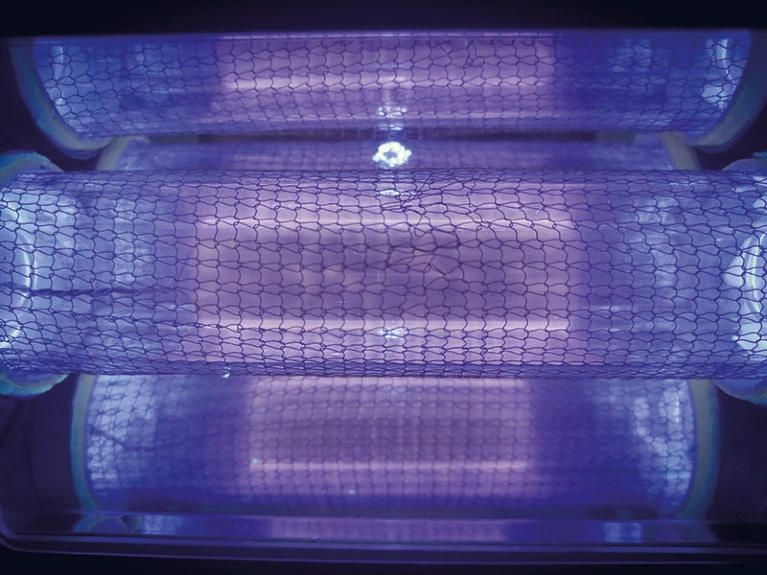
A krypton chloride excimer ultraviolet lamp.
Ewan Eadie
This is because wavelengths below 254 nm don’t penetrate tissues nearly as well, says David Brenner, a physicist specializing in radiological research at Columbia University. Far-UV light with a wavelength of 222 nm doesn’t reach beyond the layer of dead cells on the surface of the skin or the film of tears on the surface of the eye. Because bacteria and viruses are much smaller than the thickness of those layers, Brenner and his colleagues reasoned that far-UV radiation could destroy the pathogens without damaging the skin and the eyes. The scientists tested their hypothesis with lamps containing krypton chloride gas, molecules of which release UVC radiation mainly in the 222-nm range under electrical excitation.
Originally aiming to improve disinfection in operating rooms, the Columbia team realized that far-UV radiation might also reduce airborne viral transmission. In a 2018 study, the investigators showed that more than 95 percent of influenza viruses in the air were inactivated when they floated past a low-power far-UV lamp. Brenner’s group had already shown that cells in a 3D human skin model and in mice were basically unaffected by such low doses, and other researchers found no evidence of eye damage from 222-nm radiation in rats.
When COVID-19 hit, the Columbia scientists ran analogous experiments on strains of coronavirus similar to SARS-CoV-2, again with good results. To scale up their tests, the researchers then collaborated with scientists in the U.K., including a group at Leeds University that had access to a room-size test chamber designed to contain pathogens.
The room-size experiments used Staphylococcus aureus bacteria suspended in the air. This microorganism is relatively easy to analyze and is expected to be more robust against UV radiation than coronaviruses, says Ewan Eadie, a medical physicist at the University of Dundee in Scotland and lead author of a paper that outlines the team’s findings. “We really had no idea what was going to come out at the end,” he says.
The results were excellent. “We got really rapid reduction in the level of pathogens in the room,” Brenner says. “Our equivalent air changes per hour were really big, well over 100 equivalent changes per hour.”
On the safety side, Brenner and his colleagues reported in May 2022 that they had exposed hairless mice to the radiation for 66 weeks without detecting any skin cancer. They also intended to investigate the risk to the eyes and the mechanisms of how 222-nm radiation damages pathogens.
Despite the promising laboratory tests of far-UV disinfection, there are questions about how well the technology will translate into busy public indoor spaces such as hospitals, schools and restaurants. “The labs are pretty sterile clean conditions,” Eadie says. “I’d like to see some real-world data.”
In one real-world clinical trial, researchers in Nova Scotia have been examining the use of far-UV light in nursing homes, where it’s difficult to prevent the spread of airborne diseases. The controlled study tracked the incidence of COVID and other respiratory viral infections among residents in multiple facilities, half of whom used common areas fitted with far-UV lamps. The other half had placebo lights, identical in appearance but lacking the far-UV output. Results for the trial, which concluded in 2025, are not yet published.
Nardell, meanwhile, chose an airborne-infection research facility in Emalahleni, South Africa, to study COVID. Originally designed to analyze tuberculosis infection, the facility includes a six-bed ward, the air from which is transferred to exposure rooms holding animals that easily become sick with the disease being studied—in this case, hamsters. “Hamsters are the experimental animal of choice for COVID,” Nardell says. The study was designed to test the efficacy of far-UV radiation compared with upper-room GUV systems by monitoring the hamsters for signs of sickness.
But companies aren’t waiting on peer-reviewed research. Far-UV lamp fixtures are already on the market and being installed around the world—not just in buildings but also on buses and in other infection hotspots. Some devices are even marketed for home use, although Brenner warns consumers to proceed with caution—an appliance delivering the wrong wavelengths can do damage.
Although costs of the fixtures vary widely, Nardell says that $2,000 is a ballpark retail price for a lamp installed by specialists, and the lamps have an expected lifetime of around 15 months if they run continuously. There’s hope that far-UV lamps based on light-emitting diodes (LEDs) will eventually provide cheaper and longer-lived alternatives to the gas lamps being used now, but prototype LED far-UV lamps are currently restricted to impractically low levels of power, Eadie says.
In the meantime, Nardell says that in the piano bar where he was performing, the far-UV lamps provided the equivalent of 35 air exchanges per hour, probably making it one of the safest venues for singing on the planet. When he invited Brenner and his colleagues to the bar a few years ago, they enjoyed an evening of cabaret without masks, hoping they would be protected by the invisible light shining on them. “I was pretty nervous and took lots and lots of COVID tests over the next week, but I was fine,” Brenner says.
This article is part of Nature Outlook: Pandemic Preparedness, an editorially independent supplement produced with the financial support of third parties. About this content.