
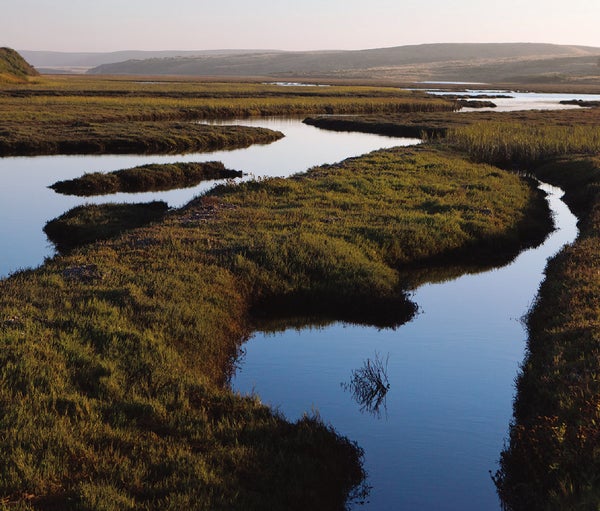
There is great opportunity where rivers and oceans meet: the salinity gradient that forms at these freshwater-saltwater boundaries holds a substantial amount of potential energy. Estuaries, for instance, could cover an estimated 40 percent of global electricity generation.
Scientists have been working for decades to turn this potential into a usable power source and have developed a number of techniques. One of the latest comes from Pennsylvania State University, where Chris Gorski, an assistant professor of civil engineering, and his colleagues say they have come up with a way to generate electricity from freshwater-saltwater ecosystems that is potentially more efficient and cheaper than previous attempts. The system, a variation on a process called capacitive mixing, works a little like a battery. It employs battery electrodes and relies on an electrochemical gradient—but unlike a battery, it is an open system (graphic below).
So far Gorski and his team have tested only a cell-phone-sized prototype in the laboratory. As reported in Environmental Science & Technology, it produced 0.4 watt per square meter—twice the power density achieved in previous capacitive mixing studies. The researchers still need to boost output and determine if the system is cost-effective and scalable (the power plant would be the size of a small warehouse in a real-world setting). They also need to investigate the potential for ecosystem disruption because the “river battery” requires the passage of large amounts of estuary water.
On supporting science journalism
If you're enjoying this article, consider supporting our award-winning journalism by subscribing. By purchasing a subscription you are helping to ensure the future of impactful stories about the discoveries and ideas shaping our world today.
Yale University chemical and environmental engineering researcher Anthony Straub and other scientists are skeptical about the possibility of building an efficient system on a river-ocean junction—and say technologies like Gorski's may ultimately only work in places with relatively extreme salt gradients, such as hypersaline lakes, geothermal wells or wastewater facilities. But if it proves viable and safe, such a system may one day join solar and wind power as a form of renewable energy.
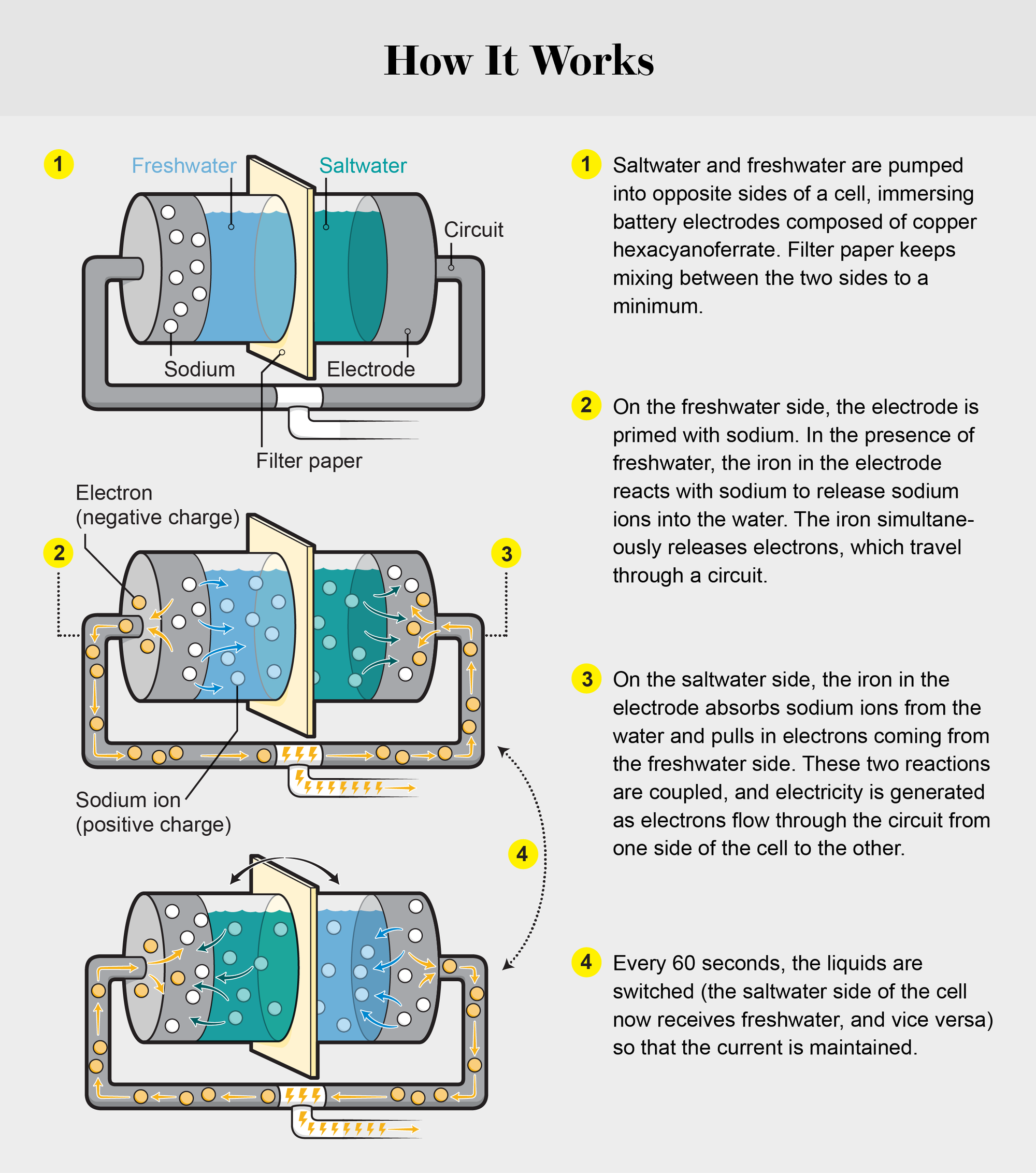
Credit: Illustration by Brown Bird Design; Source: “Harvesting Energy from Salinity Differences Using Battery Electrodes in a Concentration Flow Cell,” by Taeyoung Kim et al., in Environmental Science and Technology, Vol. 50, No. 17; September 6, 2016