
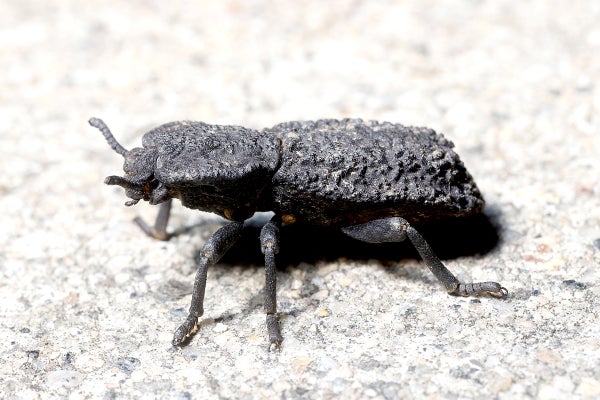
They don’t call it the diabolical ironclad beetle for nothing: Phloeodes diabolicus, a rugged insect native to western North America, has an almost supernatural ability to resist compression and blunt hits. Now, 3D scans have revealed that layered structures in its interlocking wing cases make the beetle twice as hardy as some of its relatives — and could inspire engineers to create more durable designs.
Phloeodes diabolicus’s toughness is thought to be unique among beetles. The 2.5-centimetre-long insect is notorious among collectors for being difficult to pin to a board: pins tend to bend when pushed into its exoskeleton, says entomologist Max Barclay, a senior curator at the Natural History Museum in London. The creature’s lifespan of around two years, compared with the weeks or months of typical beetles, “might justify such an extreme investment in protection”, he says.
Most beetles fly using their hind wings, which are protected by a pair of hardened wing cases — modified versions of the forewings found in other insects. However, P. diabolicus is flightless, and its wing cases have become permanently locked together as an adaptation to dry environments. “It evolved as a strategy for maintaining moisture,” says Barclay.
On supporting science journalism
If you're enjoying this article, consider supporting our award-winning journalism by subscribing. By purchasing a subscription you are helping to ensure the future of impactful stories about the discoveries and ideas shaping our world today.
To understand what makes diabolical ironclad beetles so resilient, materials scientist David Kisailus at the University of California, Irvine, and his collaborators imaged the creature using various techniques, including micro computed tomography scans using an X-ray synchrotron, a particle accelerator that produces bright beams of X-ray energy. Team member Jesus Rivera, a materials scientist at the University of California, Riverside, rigged up a device that could rotate the insect’s body inside a scanner while subjecting it to various levels of compression.
Their study, published on October 22 in Nature, shows how the beetle’s wing cases, which lock together and to the insect’s abdomen like a 3D jigsaw puzzle, are able to withstand pressure. The researchers were surprised to see that the interlocking parts of the jigsaw pieces are able to shed layers like an onion as pressure approaches breaking point, rather than being ripped off. “You’d think that if you took pieces like that and pulled them apart, they would break at the neck region,” Kisailus says. This allows the wing cases to take some damage without compromising their overall structural integrity.
The team then 3D-printed similar layered structures and found them to be twice as resistant to being pulled apart as was a type of joint commonly used by engineers. Designs inspired by these beetles could prove especially useful when joining materials with different properties, Kisailus says — for example, the metal- and carbon-based materials that are used in aerospace engineering.
This article is reproduced with permission and was first published on October 21 2020.