This Blue Alien Planet Is Not At All Earth-Like

Scientists have found a world that looks like ours, but has deadly winds and rains molten glass

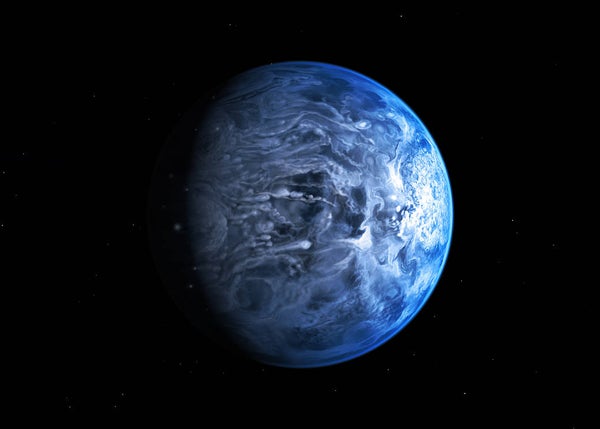
Artist's illustration of the alien planet HD 189733b, which is about the size of Jupiter. HD 189733b's blue hue is probably caused by light scattering off silicate particles in its atmosphere, scientists say.

Join Our Community of Science Lovers!

The alien planet HD 189733b is a beautiful blue dot in a sea of inky blackness, just like Earth. But that's where the similarities between the two worlds end.

For starters, HD 189733b is much bigger and hotter than Earth; it's about the size of Jupiter and zips around its host star in just 2.2 Earth days. That orbit is so close that the exoplanet is probably tidally locked, always showing one face to its star, just as the moon always shows one face (the near side) to Earth.

And then there's the weather. The winds on HD 189733b (which lies about 63 light-years from Earth, in the constellation Vulpecula) blow at up to 5,400 mph (8,700 km/h) — about seven times the speed of sound. And if that's not crazy enough for you, scientists think the rain on this world is made not of water, but of molten glass.


On supporting science journalism

If you're enjoying this article, consider supporting our award-winning journalism by subscribing. By purchasing a subscription you are helping to ensure the future of impactful stories about the discoveries and ideas shaping our world today.


Why, then, does this bizarre planet appear so superficially Earth-like? It's just a coincidence, scientists said.

"The cobalt blue color comes not from the reflection of a tropical ocean, as on Earth, but rather a hazy, blow-torched atmosphere containing high clouds laced with silicate particles," NASA officials wrote in a statement.

There may be a lot of ocean-free blue planets out there. Indeed, scientists know of two in Earth's own solar system: Uranus and Neptune. The upper atmospheres of both of these "ice giants" contain methane, which reflects blue wavelengths of sunlight back into space.

HD 189733b was discovered in 2005, and scientists figured out its color in 2013 using NASA's Hubble Space Telescope and other instruments. The exoplanet is one of six highlighted in NASA's "Galaxy of Horrors," a special Halloween gallery that the space agency put together this year. You can check out the Galaxy of Horrors here: https://exoplanets.nasa.gov/alien-worlds/galaxy-of-horrors/

Copyright 2016 SPACE.com, a Purch company. All rights reserved. This material may not be published, broadcast, rewritten or redistributed.

Mike Wall has been writing for Space.com since 2010. His book about the search for alien life, “Out There,” was published on Nov. 13, 2018. Before becoming a science writer, Michael worked as a herpetologist and wildlife biologist. He has a Ph.D. in evolutionary biology from the University of Sydney, Australia, a bachelor’s degree from the University of Arizona, and a graduate certificate in science writing from the University of California, Santa Cruz.

More by Mike Wall

SPACE.com is the premier source of space exploration, innovation and astronomy news, chronicling (and celebrating) humanity's ongoing expansion across the final frontier.

More by SPACE.com

It’s Time to Stand Up for Science

If you enjoyed this article, I’d like to ask for your support. Scientific American has served as an advocate for science and industry for 180 years, and right now may be the most critical moment in that two-century history.

I’ve been a Scientific American subscriber since I was 12 years old, and it helped shape the way I look at the world. SciAm always educates and delights me, and inspires a sense of awe for our vast, beautiful universe. I hope it does that for you, too.

If you subscribe to Scientific American, you help ensure that our coverage is centered on meaningful research and discovery; that we have the resources to report on the decisions that threaten labs across the U.S.; and that we support both budding and working scientists at a time when the value of science itself too often goes unrecognized.

In return, you get essential news, captivating podcasts, brilliant infographics, can't-miss newsletters, must-watch videos, challenging games, and the science world's best writing and reporting. You can even gift someone a subscription.

There has never been a more important time for us to stand up and show why science matters. I hope you’ll support us in that mission.

Thank you,

David M. Ewalt, Editor in Chief, Scientific American

Subscribe