
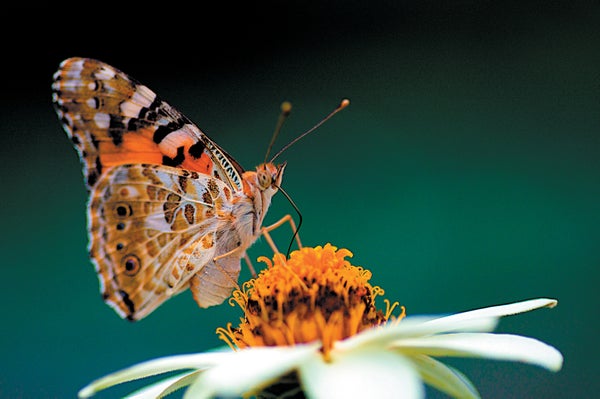
Painted ladies are the ultramarathoners of the butterfly world—even more so than monarchs. Scientists have long known about their globetrotting tendencies, but only recently have their exact migratory routes come into focus.
Over several generations the butterflies can fly up to 9,300 miles annually from Scandinavia to equatorial Africa and back. Although not every painted lady travels widely, researchers recently detailed in PNAS Nexus that certain individuals fly up to 2,500 miles from Europe to overwintering grounds in the African Sahel, journeying over the Mediterranean Sea and the Sahara Desert on the way. A few even inadvertently cross the Atlantic Ocean to South America, other researchers found. In North America, meanwhile, painted ladies flutter between Mexico and Canada. In Asia, they’ve even been spotted cutting through the Himalayas.
“They’re not passive riders on the wind,” says Arthur M. Shapiro, an emeritus lepidopterist at the University of California, Davis. “They’re directing themselves.” In ideal breeding conditions, “the air is just completely full of them,” he adds.
On supporting science journalism
If you're enjoying this article, consider supporting our award-winning journalism by subscribing. By purchasing a subscription you are helping to ensure the future of impactful stories about the discoveries and ideas shaping our world today.
Weighing less than a gram, painted ladies are too light to affix traditional tracking devices to. For the new study, University of Ottawa ecologist Megan S. Reich and her colleagues captured 40 butterflies and discerned their far-off birthplaces based on variants, or isotopes, of the chemical elements hydrogen and strontium in their wings—thereby finding the true long-haulers.
“Sometimes people think of butterflies as really fragile, ephemeral creatures,” Reich says. “But they can be quite hardy.” Painted ladies are particularly well suited to long-distance travel. No matter the location, innumerable host plants provide them with food. When it gets cold, they shiver to generate body heat. Their triangular forewings propel them at up to 30 miles per hour. Powered by yellow fat reserves, they can fly so high that, until the 2000s, people in the U.K. virtually never observed them leaving the country and therefore thought they might be dying off each winter.
Yet painted ladies are not unique. Hundreds, if not thousands, of insect species most likely migrate, including dragonflies that cross the Indian Ocean, moths that traverse Australia and plant hoppers that windsurf through East Asia. “There are some incredible insect migrations,” Reich says, most of which are never recorded.