
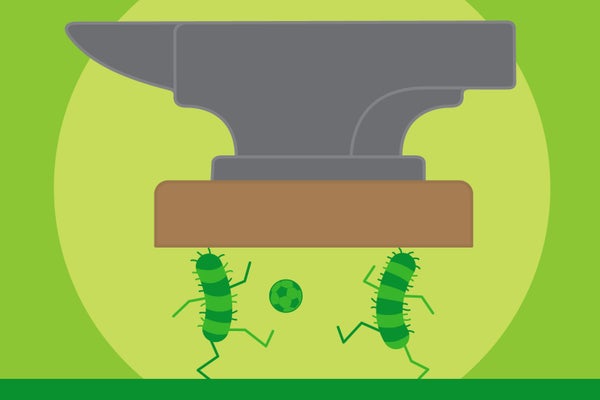
When it comes to thriving under pressure, microbes have us solidly beat. New research reveals that Carnobacterium, a genus often associated with spoiled meat, can successfully divide and replicate across an enormous range of external pressures—from the equivalent of a very thin atmosphere to crushing ocean depths. This adaptability is unknown for any other life-forms on Earth, researchers report in Astrobiology. Such hardiness suggests a single organism could survive in radically different environments throughout the solar system.
Tipped off by previous findings of various Carnobacterium strains flourishing at high and low pressures, University of Florida microbiologist Wayne Nicholson and his colleagues systematically examined 14 strains' responses to a wide span of pressure conditions. The team focused on strains isolated not only from meat (including seafood, chicken and bologna) but also from Siberian permafrost, an Antarctic lake and deep within the North Pacific's Aleutian Trench.
In the laboratory, Nicholson and his team exposed each strain to pressures ranging from 0.01 to 100 times Earth's atmospheric pressure at sea level—corresponding to the pressures on the surface of Mars and inside the liquid water ocean of Jupiter's moon Europa, respectively. The researchers found that 11 strains grew measurably at every pressure tested. Very few past studies focused on how well microbes tolerate a range of pressures, Nicholson says, but these results are nonetheless surprising given that most other organisms seem to be far more pressure-sensitive. “Humans have trouble breathing on Mount Everest,” he notes, “and that's about 30 percent of sea-level atmospheric pressure.”
On supporting science journalism
If you're enjoying this article, consider supporting our award-winning journalism by subscribing. By purchasing a subscription you are helping to ensure the future of impactful stories about the discoveries and ideas shaping our world today.
Other bacteria have been shown to do well at comparably high pressures, says Felipe Gómez Gómez, an astrobiologist at the National Institute of Aerospace Technology in Madrid, who was not involved in the study. But these results are novel because they show that the same Carnobacterium strains can endure so much pressure variation, he says: “What's really challenging is the whole range.” These microbes' ability means they could, for instance, theoretically survive at various depths in an alien ocean, Gómez Gómez adds. “This work has important astrobiological implications.”