
Two years and counting into the COVID pandemic, we’ve all seen plenty of misinformation and junk science, whether online, on cable news or even in person by those eager to share their (sigh) “alternative views.” Meanwhile, trust in public health experts and institutions is at a discouraging low. It’s easy for sensible folks to feel exhausted by trying to do the right thing for public health, or for their kids’ education, in the face of so much negativity directed toward science. So the self-titled debut album of the Sound of Science is a welcome breath of fresh air. It reminds us that science is not a threat or a conspiracy but rather a crucially important endeavor, worthy of our support and essential to understand and teach to younger generations. In this instance, you also can dance to it.
The Sound of Science was created by two British musicians, Dean Honer and Kevin Pearce, who wanted to create educational music that kids could enjoy but, at the same time, wouldn’t be “a form of torture” for parents, as Honer put it in promotion material for the album. They’ve succeeded on that front and then some, creating one of the more enjoyable listens of the year so far. Each song on The Sound of Science takes on a different scientific concept, from atoms and elements to nebulae and the speed of light.
“Gravity” is perhaps the pick of the litter here. The song’s mix of choral children’s voices and vintage synths sounds like a collaboration between Pastor T. L. Barrett and the Youth for Christ Choir in 1971 and 10 000 Hz Legend–era Air from 30 years later. It’s an irresistible ditty that starts by contrasting a text-to-speech voice inculcating on Isaac Newton with Pearce and musician Sharron Kraus singing about the sun’s mass. The Verve Children’s Choir of Sheffield then sings the album’s sharpest hook in the chorus: “Gravity’s the force that keeps your feet on the ground.”
On supporting science journalism
If you're enjoying this article, consider supporting our award-winning journalism by subscribing. By purchasing a subscription you are helping to ensure the future of impactful stories about the discoveries and ideas shaping our world today.
“These Are the Elements” is reminiscent in spirit of “200 Bars,” the closing track on the classic 1992 LP Lazer Guided Melodies by Spiritualized, where vocalist Kate Radley counts peacefully from one to 200 while a gentle, synth-driven tune percolates around her. The Sound of Science amps up the energy of the idea considerably, employing a computer-generated voice to list the elements of the periodic table (with capable help from an enthusiastic kid on background vocals) over an absolute belter of a pulsing electronic groove.
“The Water Cycle” is maybe the most sophisticated track on the record. What begins as a lush and absorbing swell of pastoral folk, with gorgeous harmonies and daubs of bubbling synths (including samples of bubbling water, naturally), suddenly explodes into a hair-raising, brief-but-epic choral cry of “Rain, hail and snow!” before fading out to the sounds of soft thunder and rainfall.
Every song, whether it’s tackling photosynthesis or global warming, has its own charming musical personality, thanks to a variety of voices (human and synthetic) and consistently inventive instrumentation.
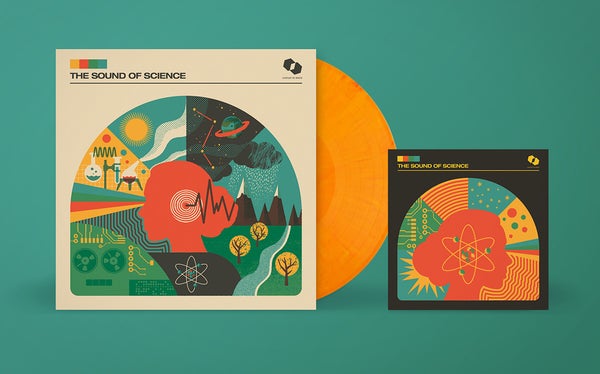
As Scientific American’s digital art director, I also appreciate that, like every release from the Castles in Space label, the graphic design of the album is just as cool as the music and a strong argument for still buying a physical product over just streaming the audio.
You can hear more of the Sound of Science on Bandcamp. And you can also take a listen to Scientific American’s carefully curated Spotify playlist of other science-inspired electronic bangers (embedded below) and check out our indie rock, ambient and heavy metal science song playlists on our Spotify channel.