
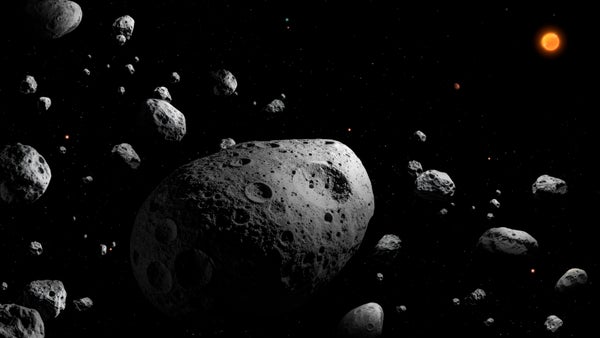
At 710 meters (just under half a mile) wide, this space rock sets a record for how fast it spins on its axis: about one rotation in less than two minutes. That makes it the fastest-spinning asteroid with a diameter of more than 500 meters ever found.
And it’s not alone. The asteroid, discovered using the Vera C. Rubin Observatory in Chile, is one of 19 large fast-rotating asteroids found with the observatory.
The discovery, made by researchers at the U.S. National Science Foundation National Optical-Infrared Astronomy Research Laboratory (NOIRLab) and the Department of Energy’s SLAC National Accelerator Laboratory and their colleagues at other institutions, was presented on Wednesday at the annual American Astronomical Society meeting. It was also published in the Astrophysical Journal Letters.
On supporting science journalism
If you're enjoying this article, consider supporting our award-winning journalism by subscribing. By purchasing a subscription you are helping to ensure the future of impactful stories about the discoveries and ideas shaping our world today.
Studying these asteroids’ size, spin and composition could reveal how they were formed—and offers clues to the early solar system.
“Clearly, this asteroid must be made of material that has very high strength in order to keep it in one piece as it spins so rapidly,” said Sarah Greenstreet, an assistant astronomer at NOIRLab, in a statement. The findings suggest it may be similar to solid rock, something that she described as surprising because most asteroids are thought to be a gravelly conglomeration of rock, dust, ice and other debris.
Rubin is set to begin a 10-year survey of the night sky later this year. It will take snapshots every three days and generate 20 terabytes of data every night—more than 350 times that produced by the James Webb Space Telescope.
“Discoveries like this exceptionally fast-rotating asteroid are a direct result of the observatory’s unique capability to provide high-resolution, time-domain astronomical data, pushing the boundaries of what was previously observable,” said Regina Rameika, the DOE’s associate director for High Energy Physics, in the same statement.