This Super Speedy Bird Barely Stops to Sleep

Common swifts zoom around at almost 70 miles per hour and may sleep while in flight

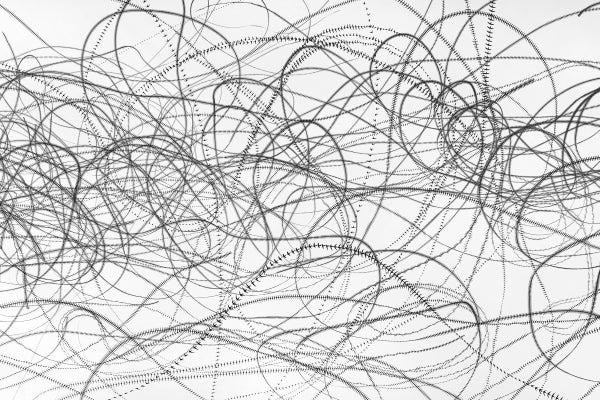
These lines are the flight patterns of common swifts

These lines are the flight patterns of common swifts (Apus apus), in the city of Barcelona, June 2019.

Join Our Community of Science Lovers!


On supporting science journalism

If you're enjoying this article, consider supporting our award-winning journalism by subscribing. By purchasing a subscription you are helping to ensure the future of impactful stories about the discoveries and ideas shaping our world today.


What look like tangled lines of abstract art are actually the result of time-lapse photography of the dizzying flight patterns of the common swift (Apus apus) taken in Barcelona, Spain, in June 2019. “Every morning and afternoon they join in groups to fly in circles or chase each other. They have many different flight behaviors; that's why it’s one of my favorites birds to work with,” says photographer Xavi Bou, who took the shot as part of a long-term project called Ornithographies. The aim of the project is to make these otherwise invisible flight paths visible to humans. From their breeding grounds across Europe and Asia to their wintering grounds in Southern Africa, the dark brown birds capture food and material for their nests while airborne. In fact, a 2016 study in Current Biology that attached small sensors that measured movement to several swifts in Sweden showed that they stayed aloft for 99 percent of their 10-month nonbreeding season. The finding raises the possibility that common swifts sleep while airborne, as some other bird species have been shown to do. Swifts can also live up to their name: a 2010 study in the Journal of Avian Biologyclocked one bird flying at 69.3 mph, the fastest on record for any bird during level flight. The species seems to turn on its turbo drive during “screaming parties,” a social display where they swoop and circle and make high-pitched calls to each other.

Science in Images

Andrea Thompson is senior desk editor for life science at Scientific American, covering the environment, energy and earth sciences. She has been covering these issues for nearly two decades. Prior to joining Scientific American, she was a senior writer covering climate science at Climate Central and a reporter and editor at Live Science, where she primarily covered earth science and the environment. She has moderated panels, including as part of the United Nations Sustainable Development Media Zone, and appeared in radio and television interviews on major networks. She holds a graduate degree in science, health and environmental reporting from New York University, as well as a B.S. and an M.S. in atmospheric chemistry from the Georgia Institute of Technology. Follow Thompson on Bluesky @andreatweather.bsky.social

More by Andrea Thompson

It’s Time to Stand Up for Science

If you enjoyed this article, I’d like to ask for your support. Scientific American has served as an advocate for science and industry for 180 years, and right now may be the most critical moment in that two-century history.

I’ve been a Scientific American subscriber since I was 12 years old, and it helped shape the way I look at the world. SciAm always educates and delights me, and inspires a sense of awe for our vast, beautiful universe. I hope it does that for you, too.

If you subscribe to Scientific American, you help ensure that our coverage is centered on meaningful research and discovery; that we have the resources to report on the decisions that threaten labs across the U.S.; and that we support both budding and working scientists at a time when the value of science itself too often goes unrecognized.

In return, you get essential news, captivating podcasts, brilliant infographics, can't-miss newsletters, must-watch videos, challenging games, and the science world's best writing and reporting. You can even gift someone a subscription.

There has never been a more important time for us to stand up and show why science matters. I hope you’ll support us in that mission.

Thank you,

David M. Ewalt, Editor in Chief, Scientific American

Subscribe