
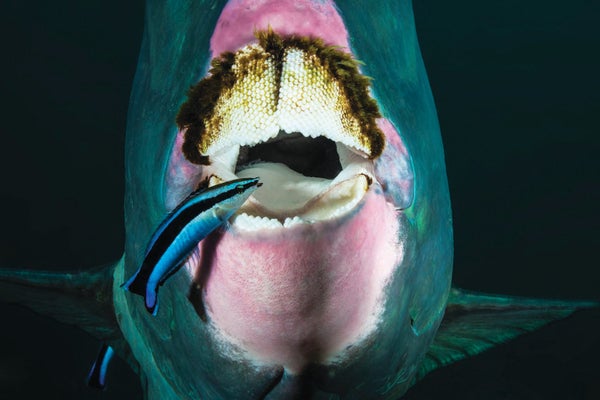
Bluestreak cleaner wrasses are entrepreneurial fish. This tiny, shiny species sets up shop in coral reefs, where it eats parasites off of client fish, some of them big and hungry. It's a dangerous business that requires impeccable social skills. No wonder, then, that these fish can identify other individuals by their faces—and even recognize their own, according to a recent study in the Proceedings of the National Academy of Sciences USA. After a week with a mirror in their tank, cleaner wrasses seem able to spot themselves in photos. The researchers say this recognition suggests the fish are self-aware, a controversial interpretation.
“Fish are much more clever than previously believed,” says the study's senior author Masanori Kohda, a comparative cognitive scientist at Osaka Metropolitan University in Japan. In 2019 his team published the first evidence that fish can recognize themselves in mirrors. For that study, the researchers put a parasitelike mark on cleaner wrasses' throats; when the fish saw their reflection, they rubbed themselves on rocks to remove the dot.
“Every possible imaginable creature” has been given similar tests, says Alain Morin, a cognitive psychologist at Mount Royal University in Canada, who was not involved in the study. Chimps and orangutans pass, although most other animals fail—possibly because the task doesn't mesh with many species' natural behaviors.
On supporting science journalism
If you're enjoying this article, consider supporting our award-winning journalism by subscribing. By purchasing a subscription you are helping to ensure the future of impactful stories about the discoveries and ideas shaping our world today.
So what mental skills let cleaner fish succeed? Kohda's team tested whether mirror-acquainted fish could recognize their own faces in a still image. Each fish examined four photos: one of itself, one of an unfamiliar cleaner wrasse, one of its own face on the stranger's body, and one of its own body with the stranger's face. Cleaner wrasses behaved aggressively toward the ones with the stranger's face but not with their own. If the photos with their face had a parasitelike mark, they tried to scrape it off their real bodies.
To Kohda, this reaction suggests these fish have “private self-awareness,” or a mental-image understanding of themselves. Morin, however, disagrees that mark tests can reveal such cognitive capability. In a photo, “you don't see your thoughts. You don't see your emotions. You see your body,” he says, adding that connecting this behavior to the fish's internal world rests on many unproven assumptions.
Still, the results do show these fish possess an “ability to flexibly adjust their behavior,” says University of Cambridge marine behavioral ecologist Katie Dunkley, who was not involved in the study. Given that their lives depend on customer service, she says, facial-recognition skills make sense.
Such experiments can reveal insight into another being's perspective on the world. The authors plan to test other sea creatures and probe what self-awareness might mean in organisms without language. But for now the minds of fish are still unknowable.