
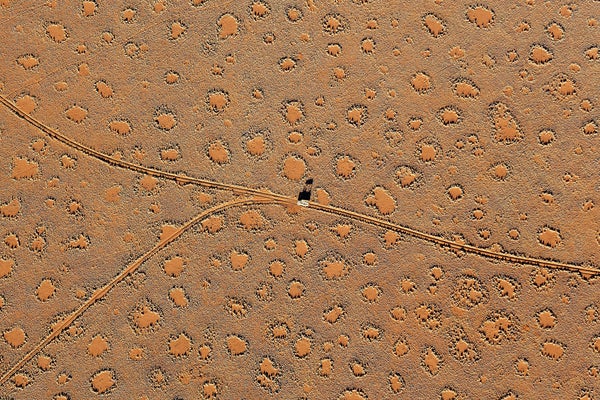
In the remote grasslands of southwestern Africa’s Namib Desert and the Pilbara region of Australia some 6,000 miles away, large, barren circles crowd the landscape, like holes stamped out by a cookie cutter in a sheet of dough. The peculiar pockmarks, called “fairy circles,” were thought to exist exclusively in those two arid stretches. But new research published recently in the Proceedings of the National Academy of Sciences USA has uncovered 263 additional sites where fairy circles might exist in areas from Madagascar to southwestern Asia.
For years, fairy circles—named for their resemblance to the circular formation of mushrooms known as “fairy rings”—have fascinated scientists and stirred up an intense debate over their provenance. Even now, there is no obvious reason to explain why these circular patches of soil exist within some of Earth’s most inhospitable and arid terrains. The new study may complicate efforts to answer that question.
The researchers trained an artificial intelligence model to comb through more than half a million satellite images of dryland regions looking for patterns that mimicked known fairy circles. Among the new locations with potential fairy circles, the researchers found common soil and climate characteristics, such as low nitrogen and a lack of rainfall, respectively. Because the study used an observational approach, the results can’t pinpoint the mechanism behind the patterns, says lead author Emilio Guirado, applied and environmental scientist at the University of Alicante in Spain. But the findings suggest fairy-circle-like patterns are most likely to exist in soil with very low moisture.
On supporting science journalism
If you're enjoying this article, consider supporting our award-winning journalism by subscribing. By purchasing a subscription you are helping to ensure the future of impactful stories about the discoveries and ideas shaping our world today.
Several explanations offered in the past—such as toxins from the leaves of plants in the genus Euphorbia or gaseous emissions from below the ground—have fallen out of favor. Only two theories seem to persist in the ongoing debate: The first, proposed by ecologist Norbert Jürgens, holds that competing colonies of underground sand termites left the circular stamps. He believes the termites engineer their surroundings by chewing through the roots of the grass to create a kind of reservoir for storing water. The second, endorsed byecologist Stephan Getzin of the University of Göttingen in Germany, among others, proposes that the grasses are the ecosystem engineers and self-organize into the circular patterns. That theory contends that grass takes advantage of the circular gap as a water resource and wouldn’t be able to survive in the arid landscape without the geometric formation. (Neither Jürgens nor Getzin were involved with the new paper.)
Fiona Walsh, an ethnoecologist and staff member of the University of Western Australia, has studied the phenomenon in Australia but was not involved in the new research. Her work incorporates the knowledge of the local Martu people, an Aboriginal group that calls the circles linyji. Walsh’s research describes the circles as termite pavements. “They’re the roofs of subterranean termite cities; that’s a way to visualize them,” she says. “The roofs are concrete-hard and have very low or no mounds.” But she says the origin of the phenomenon remains unclear, and the termites are one player in a larger system.
Understanding why fairy circles, or FCs, form is just a single piece of the puzzle. Scientists haven’t even yet agreed on a precise definition. “There is no universally agreed definition of what a fairy circle is,” says Fernando Maestre, a University of Alicante ecologist and co-author of the new paper. He and his colleagues used the term “FC-like” for the patterns identified in their research that share the same main characteristics of the fairy circles reported in Namibia and Australia.
One of these characteristics is a spatially periodic pattern: the tendency of fairy circles to exist in a gridlike formation with very little variation in the distances between them, Getzin says. His previous research had posited that fairy circles are arranged in a hexagonal formation in which one circle is a focal point, positioned in the center of six others and at approximately the same distance from each.
None of the patterns in the new research, Getzin says, fit that description exactly (though he does think the authors did a “very good job” in identifying the environmental drivers of vegetation gaps in dryland areas). “The study dilutes the term fairy circles, and it ignores the definition of fairy circles in the process,” he says. Getzin adds that the findings confirm “true fairy circles” only exist in the Namib Desert and Western Australia. Even with the systematic global search in the new study, he says, “the authors failed to find spatially periodic vegetation gaps that are as strongly ordered as the genuine fairy circles.”
Walter Tschinkel, a Florida State University biologist, who has previously studied fairy circles and was not involved in the new study, agrees. “You’d have to convince me that they’re fairy circles; they’re not regular enough,” he says. “These are just gaps in vegetation,” a broad description of a variety of distinct, self-organized patterns in nature that usually form to transport water in dry landscapes. “In arid zones, vegetation is rarely a uniform carpet, it always consists of a lumpy distribution,” Tschinkel says.
Michael Cramer, an ecologist at the University of Cape Town in South Africa, who researches spatial patterns in ecosystems and also was not involved in the new research, says its application of AI technology to this field is a major step forward. He also questions some of the results, however. In particular, he says, a few of the patterns are too small—just six feet across—compared with known fairy circles, which tend to span about seven to 39 feet across. A number of the sites deserve a visit to confirm the existence of the circles, Cramer notes.
Lead author Guirado says the critiques “are not well-founded and do not undermine our findings in any way,” in part because there is not a precise definition of the phenomenon.
Walsh says the new research “clearly shows this pattern is widespread within Australia” and that the circle formations there don’t exist in isolation—they resemble other patterns found around the world.
The study authors remain undeterred by the mixed responses to their paper. “As expected in a topic as hotly debated as fairy circles, some researchers have criticized our work, and others have supported it,” Maestre says. He hopes the findings will open the door to novel research on the patterns in these new locations.