
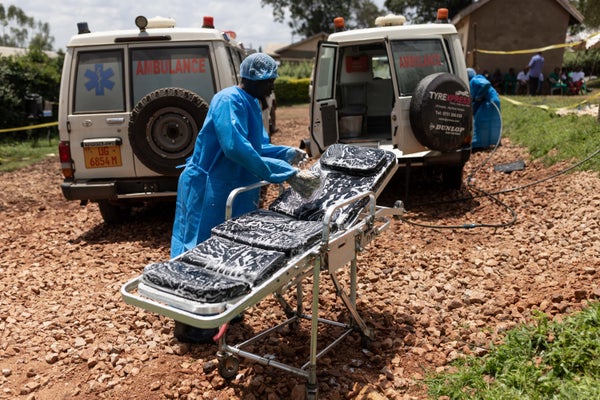
An ongoing Ebola outbreak has infected and killed dozens of people in Uganda. Health authorities in the country and the World Health Organization (WHO) have announced plans to begin a clinical trial for three Ebola vaccine candidates. Licensed vaccines for Ebola exist, but they are not effective against Sudan ebolavirus, the species responsible for the outbreak.
Doses of the vaccine candidates are expected to be delivered to Uganda this week. The clinical trial is the latest effort to stem an outbreak that has already spread to nine districts, including three densely populated areas, according to the WHO.
The candidates for the trial include one that is a bivalent (meaning it targets two viral strains) and two that are monovalent (targeting a single strain each): a bivalent adenovirus vectored vaccine made by the University of Oxford and the Jenner Institute in England, a monovalent adenovirus vectored vaccine developed by the Sabin Vaccine Institute and a monovalent vaccine from the International AIDS Vaccine Initiative.
On supporting science journalism
If you're enjoying this article, consider supporting our award-winning journalism by subscribing. By purchasing a subscription you are helping to ensure the future of impactful stories about the discoveries and ideas shaping our world today.
As of November 21,141 confirmed cases and 55 confirmed deaths had been reported. Of the 19 health care workers who have been infected, seven have died.
At the outset of the current outbreak in Uganda, WHO officials said a clinical trial for vaccine candidates with sufficient data would go ahead only if more cases continued to be reported. But the agency later revealed it was already in talks with the vaccine developers, and an existing protocol for vaccine trials that had been deployed during previous outbreaks with the Zaire ebolavirus strain was being put in place for the Ugandan outbreak.
In light of the urgency of the Ebola outbreak in Uganda, the WHO asked the COVID-19 Vaccine Prioritization Working Group to rapidly evaluate candidate Ebola vaccines to be included in a planned clinical trial in the area. The evaluators considered safety, efficacy and logistics of the candidate vaccines, the global health body said in its recommendation.
Ana Maria Henao-Restrepo, co-lead of the R&D Blueprint for epidemics at the WHO’s Health Emergencies Program, explains that because there is no evidence that the new Ebola vaccine candidates are effective, vaccine doses will be given only to individuals known to be at a high risk of getting infected
“This is why we are doing the trial,” Henao-Restrepo says. “If data [suggest] that one or more of these candidate vaccines is efficacious, there will be an independent expert group on the trial that will review the data and advise WHO and [Uganda’s] Ministry of Health,” she says.
If any of the three vaccines is found to be effective, regulatory authorities will begin the process of granting approval and paving the way for commercialization. In parallel, the WHO’s Strategic Advisory Group of Experts on Immunization (SAGE) is expected to provide public policy recommendations to Uganda and other countries on the use of the vaccines.
Only 1,200 vaccine doses in total will be used for the study, according to the approval granted by the Uganda National Drug Authority. Henao-Restrepo says the target participants for the trial will be people who are at the highest risk of being infected with Ebola because of the nature of their work and close contact with infected people, including health care workers. “We have learned from previous outbreaks that the risk of acquiring Ebola is not equal,” she says. The risk to the general population is low, but “workers in contact with the cases are the ones with the highest risk of Ebola.”
Ugandan health authorities have argued that the outbreak is under control, but Yonas Tegegn, the WHO’s representative to Uganda, notes that the best approach to stemming its spread is to have a risk-aware and fully engaged community. In addition, it will be important to bring societal leaders onboard to help the public embrace safe habits and take recommended preventive measures.
“I think that our biggest tools should be risk communication and community engagement,” Tegegn says. Those are areas “in which we haven’t seen much investment from our partners. We would like our partners and donors to make resources available to address these issues.”
In the early weeks of an outbreak, says Patrick Otim, health emergency officer of the Acute Events Management Unit at the WHO’s Regional Office for Africa, the response relies on the continual cooperation of the affected communities—and Ugandan community members have generally been cooperating. But Kyobe Henry Bbosa, Ebola incident commander at Uganda’s Ministry of Health, confirms reports that relatives of a patient who died of Ebola exhumed the body for a religious ritual, an act that appears to have led to more people getting infected and at least nine deaths.
“This has not since happened, and we think it will not happen again,” Otim says. “But we also need to understand that at the beginning of this outbreak, the level of awareness and concern for Ebola among the population was low.”
Adhering to the Ministry of Health’s guidance took time, but Ugandans seem to be aware of the Ebola risk now. Otim adds that the intensity of infection in the epicenter districts has actually calmed down, and there are now fewer cases coming from those regions. The biggest remaining worry is that the outbreak will spill into major cities, he says.
Elsewhere, health authorities are on alert for the virus. The U.K. Health Security Agency (UKHSA) temporarily shut down the urgent care center at Colchester General Hospital in England for about a day’s time last week because of a possible Ebola case. But UKHSA later said
that there were “currently no confirmed cases of Ebola in the U.K.”