
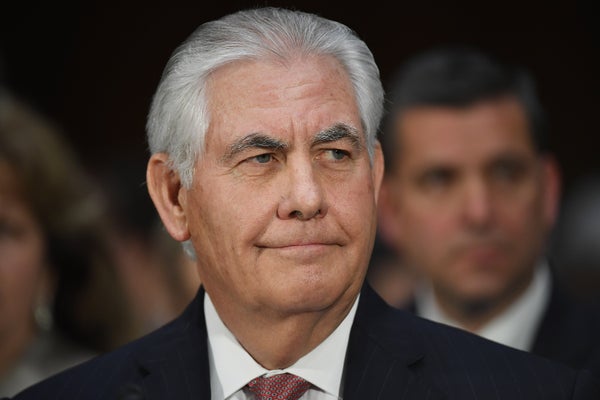
A key Senate committee voted along party lines yesterday to endorse former Exxon Mobil Corp. CEO Rex Tillerson for secretary of State, paving the way for easy approval by the full Senate.
The Senate Foreign Relations Committee voted 11-10 to back President Trump's top diplomatic pick. The green light came after Tillerson's sharpest GOP critic, Sen. Marco Rubio of Florida, announced he would support the nomination despite lingering concerns, especially about Tillerson's reluctance to condemn Russian President Vladimir Putin.
"The president deserves the chance to succeed and therefore should be given significant deference in choosing Cabinet positions," Rubio said yesterday before casting his vote.
On supporting science journalism
If you're enjoying this article, consider supporting our award-winning journalism by subscribing. By purchasing a subscription you are helping to ensure the future of impactful stories about the discoveries and ideas shaping our world today.
He expressed a continued "fundamental concern" about whether Tillerson would "pursue a foreign policy of dealmaking at the expense of traditional alliances and at the expense of human rights and democracy."
Rubio's commitment followed a joint announcement by Sens. John McCain (R-Ariz.) and Lindsey Graham (R-S.C.) to back Tillerson on the floor, essentially cinching the nomination for him.
But while several Democrats emerged from office meetings with the veteran oilman early this month saying they were reassured by some of his positions — like his belief in man-made climate change — none supported Tillerson in committee.
Many noted that even though Tillerson parts ways with Trump in saying that human-caused emissions at least play a role in driving warming, his refusal to discuss Exxon Mobil's role in obscuring climate research and his caution on U.S. leadership on global climate engagement helped fuel Democratic opposition to his confirmation.
"Mr. Tillerson provide[d] insufficient reassurance that the United States would meet its commitment to the Paris climate accord," Sen. Ed Markey (D-Mass.) said in a statement before the vote. "He also refused to embrace the scientific view that climate change is now overwhelmingly driven by the burning of fossil fuels and failed to answer legitimate questions about Exxon's support for climate denial groups during his tenure."
Corker suggests U.S. could stay in Paris deal
Tillerson received scant credit for telling the committee during his Jan. 11 hearing that the United States should keep a "seat at the table" when it comes to global climate deals.
Chairman Bob Corker (R-Tenn.) held out Tillerson's more moderate view on warming and his background as an engineer as possible reasons Democrats would back him earlier in the process. Yesterday, he expressed disappointment that Democrats seemed to be using the confirmation as a "proxy vote" for Trump.
Corker argued that Tillerson and not Trump would set the administration's policy. While Trump has repeatedly promised to withdraw the United States from the 2015 Paris Agreement, for example, Corker seemed to predict that the president's foreign policy team would not rush to undo the deal.
"If you look at the Paris Agreement, I'm not trying to be pejorative here, but there are no requirements whatsoever on our country for the next four years," Corker said. "None."
He said he did not expect an executive agreement or action soon calling for a withdrawal.
"It really doesn't make sense to just step out there and do something different," he said. "It probably makes sense to develop your own policies in that regard and see how it coincided with what was agreed to in the Paris Agreement."
The Paris deal does call on countries to reconsider their 2015 commitments, starting with a "facilitate dialogue" at a summit in Poland at the end of next year, with a view toward tightening those commitments by 2020. The Trump team could loosen the Obama-era commitment instead, which calls for a 26 to 28 percent greenhouse gas emissions cut below 2005 levels by 2025.
Not all conservatives are as sanguine about Trump abandoning his campaign pledge to scrap Paris as Corker seems to be.
Divided over Exxon conflicts
Sterling Burnett of the Heartland Institute told E&E News yesterday that he had received positive feedback for his think tank's suggestion that the administration should pull out of the underlying U.N. Framework Convention on Climate Change altogether. Still, he said, the Trump team seemed to have rejected suggestions that it submit the Paris deal to the Senate for ratification, where it would likely die.
He called Tillerson "a bit of an enigma" on climate change.
"But Trump has proven pretty maverick, and my suspension is that he'll make decisions and tell them what we're going to do," said Sterling. He called Paris withdrawal a "fait accompli."
But Democrats on the committee predicted that the Trump administration would meet with substantial public resistance if it tries to withdraw from the deal.
"If you think the political activism was intense this weekend, wait till you see what happens if the administration tries to back away from a climate deal that the U.S. led," said Sen. Tim Kaine (D-Va.), referring to the Women's March on Washington and similar events in cities around the world.
In a brief interview with E&E News, Sen. Jeff Merkley (D-Ore.) said he doesn't know enough about Tillerson and joint business agreements between Exxon and state-run oil companies overseas.
"When Exxon diverted their royalty payments into the personal bank account of President — or dictator for life — Obiang, rather than giving it to the government of Equatorial Guinea, that is a moral issue," Merkley said, referring to Teodoro Obiang Nguema Mbasogo, the country's president, who has been in power since 1979. "It is a strategy that props up a dictator at the expense of how those resources could be spent on behalf of that nation."
Obiang and members of his family have long faced investigations of money laundering, and Exxon's activity in the coastal African nation has raised questions of Foreign Corrupt Practices Act violations.
He called Tillerson's climate change comments "adjusted talking points" to acknowledge that climate change is real but said they encourage little action.
"He has no sense of, or understanding of, this issue, and that alone is disqualifying," Merkley added.
Sen. Jim Risch (R-Idaho) said he is not concerned that Tillerson could feel torn between his old company and the American public.
"No, absolutely not. The man's an American; he's resigned from Exxon, and he's committed to do the job that he was designated to do here," Risch said. "There's gonna be thousands, tens of thousands of people looking over his shoulder, including all of you, including us, and I'm not concerned about that at all."
Reprinted from Climatewire with permission from E&E News. E&E provides daily coverage of essential energy and environmental news at www.eenews.net.