
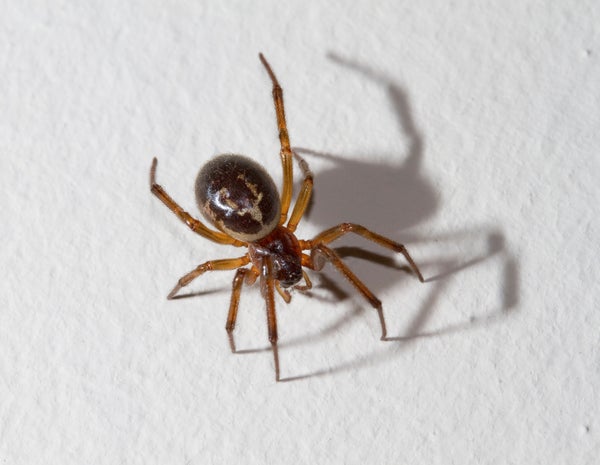
Dawn Sturgess looked out her bedroom window in southern England one day last summer just in time to witness an arachnophobe’s nightmare: a shrew was tangled in a spider’s web, and its ability to struggle was quickly weakening as the arachnid’s venom shut down the tiny mammal’s nervous system.
Over the next 20 minutes, Sturgess watched the female noble false widow spider hoist the immobilized, matchbox-sized Eurasian pygmy shrew—which was many times larger than the spider—nearly 10 inches upward into the rafters of the home, where the tiny predator chemically liquified and consumed its meal.
“I stood on the other side of the window, watching, for ages,” says Sturgess, a citizen scientist who filmed the entire interaction on her phone. “I was fascinated by the spider’s strength and determination to take its prey home!”
On supporting science journalism
If you're enjoying this article, consider supporting our award-winning journalism by subscribing. By purchasing a subscription you are helping to ensure the future of impactful stories about the discoveries and ideas shaping our world today.
While this is the first confirmed case of a noble false widow spider devouring a shrew in the United Kingdom, it isn’t the first time these ravenous arachnids have been seen taking down relatively large prey. According to a recent Ecosphere study co-authored by Sturgess and researchers at the Venom Systems & Proteomics Lab at the University of Galway in Ireland, this is the third documented case of a noble false widow spider preying on a vertebrate in the past five years. This suggests that small mammals such as the pygmy shrew—a protected animal in the U.K.—may be a more frequent item on spiders’ menus than previously thought.

Noble false widow spiders (Steatoda nobilis) are native to the Canary Islands. They reached England in the 1870s, after stowing away on ships carrying bananas and ornamental plants. The spiders have since spread into mainland Europe and the Mediterranean and eventually into South America and California. They adapt well to unfamiliar regions because they are cold-tolerant and relatively long-lived—and can pump out up to 1,000 offspring in a single year.
Another helpful factor in their longevity is their versatile diet. John Dunbar, one of the University of Galway researchers who led the new study, says noble false widow spiders have been known to feast on a vast range of arthropods, from flies and wasps to centipedes and other spiders. The new finding adds evidence that these spiders—whose length maxes out at half an inch—also hunt bigger game. In recent years, Dunbar’s team has also seen a common ground lizard and a small bat tangled up in a noble false widow spider’s sticky web.
“The fact that this spider was able to lift a shrew 10 times its size was truly remarkable,” says Jose Valdez, an ecologist at the German Center for Integrative Biodiversity Research, who published a literature review of vertebrate-eating arthropods in 2020. “The ability to lift such a large prey item suggests that the spider may be well adapted to hunt larger prey in its environment,” adds Valdez, who was not involved in the new study.
Many vertebrate-eating spiders are mammoth, at least in arthropod terms. A prime example is the aptly named goliath bird-eating spider, the world’s largest spider. With leg spans up to 11 inches across, this tarantula can turn just about anything smaller than itself into dinner, including frogs, lizards, mice and, of course, birds.
Unlike goliath birdeaters, the much smaller noble false widow spider can’t outmuscle its prey. Instead it relies on a deadly combination of strong silk and powerful venom. Its web, a messy tangle of silk threads, makes an excellent snare. The spider then injects a potent concoction of neurotoxins that can paralyze small vertebrates such as pygmy shrews in a matter of minutes, Dunbar says.
Then it’s time to eat. The venom is loaded with proteins that break down tissues, and the spider also expels digestive juices to help liquify the meal—and then it slurps up the soupy remains, sometimes over the course of several days. In the case of the pygmy shrew, the only scraps the researchers found after three days were inedible fur, bone and skin.
Among noble false widow spiders, so far only adult females have been observed eating vertebrates. This is likely because female spiders need to gather as much food-derived energy as possible to produce their prodigious numbers of offspring.
“A vertebrate would be a fine meal for a spider, so when they have the chance, they pounce,” says Whit Gibbons, a herpetologist at the University of Georgia, who was not involved in the new paper. Last year Gibbons published a study that found that around 30 percent of spider families consume vertebrates. For example, a triangulate cobweb spider (which comes from Eurasia and is a close relative of the noble false widow spider) has been observed subduing a garter snake that was 355 times heavier than itself. Similarly sized brown widow spiders have successfully dispatched rats. “I think spiders in general fall into one of the many categories of animals that engage [with] a broader diversity of prey than assumed,” Gibbons says.
Despite noble false widow spiders’ taste for large prey, Dunbar doubts the arachnids will ever pose a serious threat to vertebrates such as pygmy shrews. But he thinks it is important to keep tabs on what these eight-legged invaders are eating. “It is very likely we will see other types of small vertebrates falling prey to the noble false widow [spiders] as they continue to expand their range,” he says. “It adds a new dimension to their invasiveness.”