September 17, 2009
1 min read
 Add Us On GoogleAdd SciAm
Tiny tyrannosaur had all the trappings of T. rex
Millions of years before the first tremendous Tyrannosaurus rex began terrorizing fellow animals, Raptorex kriegsteini showed all of the characteristic tyrannosaur features—in miniature.
On supporting science journalism
If you're enjoying this article, consider supporting our award-winning journalism by subscribing. By purchasing a subscription you are helping to ensure the future of impactful stories about the discoveries and ideas shaping our world today.
Millions of years before the first tremendous Tyrannosaurus rex began terrorizing fellow animals, Raptorex kriegsteini showed all of the characteristic tyrannosaur features—in miniature.
Weighing in at about 1 percent of the latter theropod's mass, Raptorex hunted with the same bipedal gait, stubby arms and keen sense of smell as its daunting cousin. Despite being a fairly diminutive dino, it still was nearly three meters long, weighed about 80 kilograms and would have been a fearsome match for a midsize mammal like a human.
"There's no other example that I can think of where an animal has been so finely designed at about 100th the size that it would eventually become," Paul Sereno, a paleontologist at the University of Chicago, said in a prepared statement. He and five other co-authors describe the new carnivore in a paper in Science today.
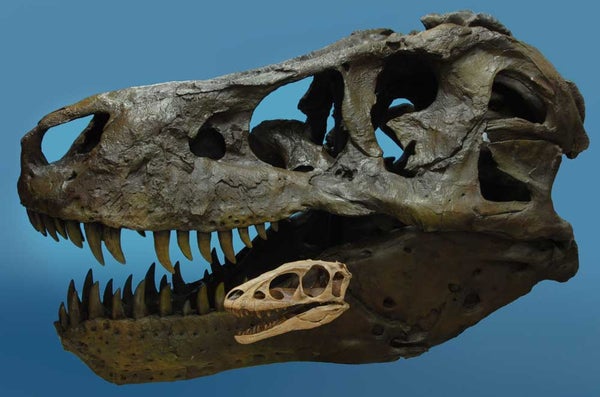
In this image, the Raptorex's skull is shown to be just a fraction the size of a full-grown T. rex skull.
It’s Time to Stand Up for Science
If you enjoyed this article, I’d like to ask for your support. Scientific American has served as an advocate for science and industry for 180 years, and right now may be the most critical moment in that two-century history.
SciAm always educates and delights me, and inspires a sense of awe for our vast, beautiful universe. I hope it does that for you, too.
If you subscribe to Scientific American, you help ensure that our coverage is centered on meaningful research and discovery; that we have the resources to report on the decisions that threaten labs across the U.S.; and that we support both budding and working scientists at a time when the value of science itself too often goes unrecognized.
In return, you get essential news, captivating podcasts, brilliant infographics, can't-miss newsletters, must-watch videos, challenging games, and the science world's best writing and reporting. You can even gift someone a subscription.
There has never been a more important time for us to stand up and show why science matters. I hope you’ll support us in that mission.