
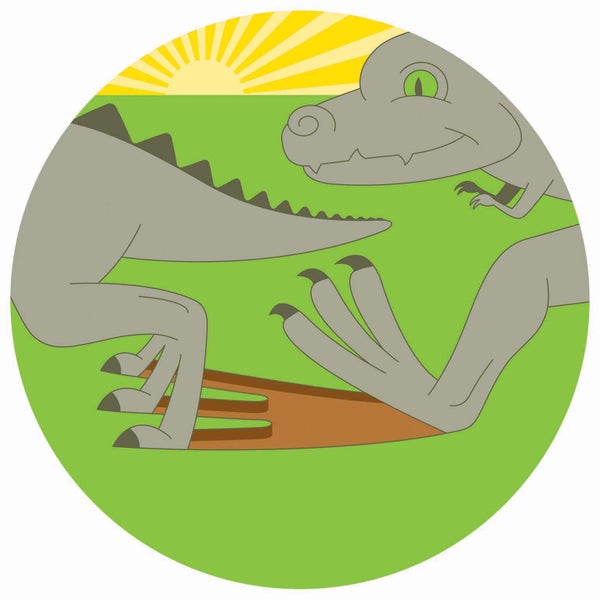
Paleontologists know little about what giant, bone-crushing tyrannosaurs were like as babies. Hatchling fossils are rare and provide few hints about these foot-high carnivores’ behavior. But now miniature trackways, found in rock roughly 72 million years old, offer evidence that baby tyrannosaurs traveled in pairs.
Paleontologists first found the trackways during a riverbank survey of southwestern Alberta’s St. Mary River Formation. The site is rife with tracks made by many dinosaur species—“a busy time at the beach,” as Royal Tyrrell Museum of Palaeontology researcher Donald Henderson and his colleagues describe it in the Canadian Journal of Earth Sciences. Among the fossil footprints are seven miniature dinosaur trackways suggestive of individuals moving in pairs. “The form of the small tracks, as well as the pace lengths, is a good match to what could be produced by hatchling [tyrannosaurs] Albertosaurus or Gorgosaurus,” Henderson says, noting that the tracks’ pointed claw tips suggest a predator.
Existing knowledge about tyrannosaur behavior comes mostly from fossilized bitten bones and a few scarce tracks. Injured skulls show that tyrannosaurs fought by biting one another on the face, and trackways found in British Columbia indicate that adults sometimes socialized together. “Tyrannosaurs weren’t just chompy, killing macho machines,” says fossil track expert Lisa Buckley, who was not involved in the new study. The newfound tracks hint that hatchlings formed groups after leaving the nest, similar to some herbivorous dinosaurs—as well as living crocodiles and large ground birds.
On supporting science journalism
If you're enjoying this article, consider supporting our award-winning journalism by subscribing. By purchasing a subscription you are helping to ensure the future of impactful stories about the discoveries and ideas shaping our world today.
Buckley says it’s possible the tracks came from a different carnivore type, but either way the discovery adds to what is known of dinosaur lives. “No matter which theropod group was responsible,” she says, “the footprints in this paper are fascinating because they show evidence of group behavior.”