
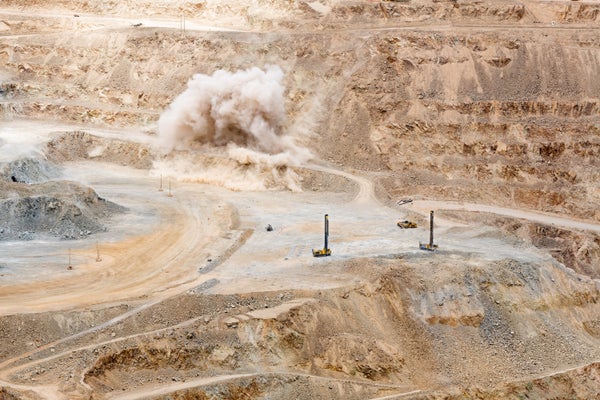
Pulling essential minerals from the ground is dirty work, and most of the stuff miners extract is useless sediment. In some Chilean copper mines, for instance, hundreds of thousands of tons of material are processed every day, “but 95 percent of that is waste,” says D. R. Nagaraj, a mining industry expert at Columbia University. To sift out precious minerals, engineers often blow air bubbles through the material in a setup called a bubbling fluidized bed—and a new twist could make this costly process more efficient.
In the current system, sediment is pushed up through a chamber by air bubbles, separating particles of different sizes so dirt can be skimmed off the top. But the procedure uses a lot of water and energy, partially because the air bubbles’ chaotic motion reduces their efficiency, says Columbia University chemical engineer Chris Boyce. “They’re coalescing and splitting and not maintaining a uniform size,” he explains, making the sorting process uneven.
In the Proceedings of the National Academy of Sciences USA, Boyce and his colleagues describe a way of keeping the bubbles in line, requiring less energy to separate minerals from refuse. They mounted the bubble-filled chamber on a platform vibrating at a consistent clip and found that otherwise chaotic air pockets lined up into ascending rows as the system shook. The vibrations make dirt particles shift between solid and fluidlike states, sometimes behaving like sand in a sandcastle, sometimes acting like grains in an hourglass, Boyce says. The researchers documented how this rapid shifting pushes the bubbles into formation—a process that previous models of gas-solid interactions could not predict, the team writes.
On supporting science journalism
If you're enjoying this article, consider supporting our award-winning journalism by subscribing. By purchasing a subscription you are helping to ensure the future of impactful stories about the discoveries and ideas shaping our world today.
The experimental results held for varying apparatus and particle sizes. This bodes well for the shift in magnitude from laboratory to industry, Boyce says.
That’s “the key question,” says McGill University materials engineer Kristian Waters, who was not involved in the study. “How can we scale up this process? Some mines are working at hundreds of thousands of tons a day in ore.”
Boyce is now collaborating with experts such as Nagaraj to put the findings to work reducing mining’s environmental footprint. Even green technologies such as electric cars need minerals, Nagaraj says, so “if mining is not sustainable, nothing else will be.”